
Phoenix Home Services Marketing: 7 Budget Moves Built Around the Heat Cycle
A month-by-month 2026 playbook for shifting ad spend before summer AC demand spikes and shoulder-season leads quietly dry up.
Phoenix home services marketing runs on a calendar most advertisers never actually write down. They know summer is busy for HVAC companies in a general sense, so they bump the budget a little in June and call it a seasonal strategy. Then July hits, every competitor does the same thing at the same time, cost per click climbs, and the business that planned nothing beats the business that planned a little, simply because it moved first.
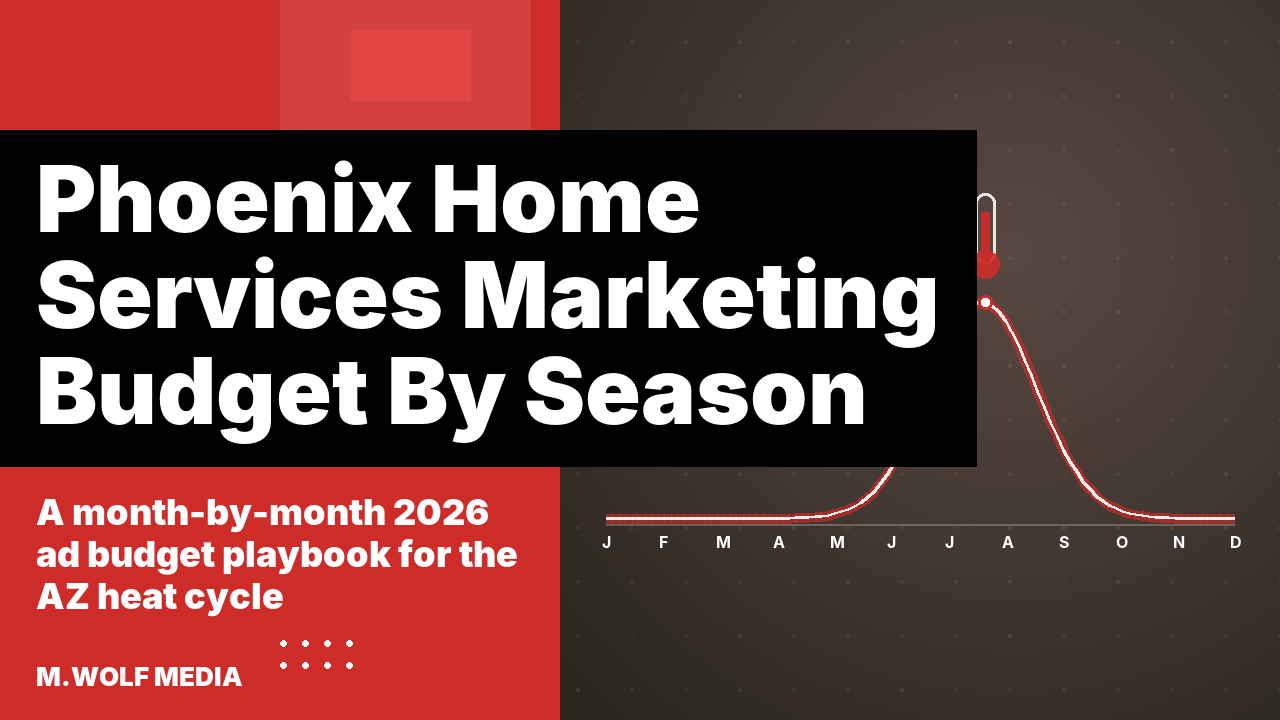
The pattern underneath Phoenix's home services demand isn't subtle. It's driven by a desert climate that swings from pleasant mid-60s highs in January to a sustained plateau above 100°F for nearly five months straight. That swing shows up in search volume, in cost per click, and in which service category is actually worth your next ad dollar, and it shows up on a schedule you can plan against months in advance instead of reacting to after the fact.
What follows is a month-by-month breakdown of how that heat curve should reshape a Phoenix home services ad budget, built from National Weather Service climate data, published search-demand benchmarks, and real seasonal patterns across the trades that ride this cycle hardest: HVAC, pool service, pest control, landscaping, and the quieter categories that fill the gaps the heat leaves behind.
Start the HVAC Ramp Before the Heat Does (March-May)
Phoenix's spring shoulder season is short and it's the cheapest window of the year to build HVAC visibility. National Weather Service data for 2025 puts the average high at 79.5°F in March, climbing to 87.1°F in April and 95.6°F in May. Homeowners are comfortable, air conditioners are mostly idle, and most competitors haven't turned their HVAC campaigns back on yet. That's exactly why it's the right time to turn yours on.
Search demand confirms the window. HVAC marketers tracking national query volume through Ahrefs' Keywords Explorer found AC repair searches climbing steadily from roughly 25,000 in February toward their July peak, well before the temperature itself forces the issue. Maintenance and tune-up keywords move first, months ahead of emergency repair terms, which means a March-to-May budget is buying cheaper clicks on exactly the audience segment, homeowners planning ahead, that an emergency-only campaign never reaches.
A practical rule: if your HVAC ad budget doesn't change shape until the first 100°F day of the year, you're already behind the advertisers who started ramping six to eight weeks earlier on tune-up and maintenance terms that cost a fraction of what "AC not cooling" will cost by June.
Go All In When the Thermometer Does (June-September)
This is the plateau, not a spike. Average highs run 106.2°F in June, 107.6°F in July, and 109.3°F in August before easing slightly to 100.5°F in September, per the same 2025 NWS data. Phoenix logged 37 individual days at or above 110°F that year. For four straight months, there is no meaningful "slow week" to plan around inside this stretch. Every day is a demand day.
The seasonal search pattern backs this up at a national level: AC repair queries jump an estimated 266% from their February baseline to their July peak, a shift from roughly 25,000 to more than 91,000 monthly searches tracked through Ahrefs. Phoenix advertisers should expect that national curve to run even steeper locally, given how few U.S. metros sustain 100°F-plus highs for this many consecutive weeks.
The businesses that win June through September aren't the ones who raised their budget the most. They're the ones who had budget left to raise, because they didn't blow it all trying to catch up in May. Mitchell Wolfert, Founder, M.Wolf Media
Cost per click rises here too. HVAC Google Ads benchmarks compiled independently by Webtonic and PPC Chief both land on roughly $9.12 as the national blended average CPC, with emergency repair terms running well above that figure and maintenance terms well below it. That blended average is a shoulder-season number pulled up by a few peak months. Budgeting the same dollar figure in July as in October means either underfunding your busiest season or overpaying for clicks all year to keep a reserve you only need for sixteen weeks. We broke down the broader cost picture in our HVAC marketing Arizona summer surge playbook, which goes deeper on Local Services Ads bidding during this exact window.
Let Pool Service Ride the Same Wave
Phoenix doesn't just run hot, it runs hot next to roughly 350,000 residential pools across the metro, one of the highest per-capita pool densities in the country according to local pool-service industry data. That density matters for marketing budgets because pool service follows almost the exact same calendar as HVAC, driven by the same thermometer.
Chlorine consumption roughly doubles in summer compared to spring and fall as heat accelerates chemical breakdown, which is why weekly service becomes the market standard from June through September instead of the biweekly cadence that works the rest of the year. Algae blooms faster, water evaporates faster, and homeowners who ignored their pool all spring suddenly need same-week help. A Phoenix home services marketing budget that treats pool service as a minor afternoon thought is leaving a second heat-driven category on the table at exactly the moment HVAC searches are getting too expensive to dominate alone.
Don't Treat Pest Control Like an Emergency Category
It's tempting to lump pest control in with the same June-through-September emergency spending logic as HVAC. The actual pattern is steadier than that. Local pest-control guidance for the Phoenix market describes peak activity running broadly from spring through fall, not a single hard summer spike, with quarterly treatment cycles as the standard recommended cadence for Arizona homes rather than a monthly peak-season push.
"Pest control is one of the few categories in Phoenix home services marketing where a flat, steady budget actually outperforms a seasonal one. Scorpions and other desert pests stay active across a six-month window, not a four-week spike, so the businesses that win are the ones running consistent visibility instead of panic-spending the second they see a bug on a lawn."
That doesn't mean pest control budgets should never move. It means the move is smaller and smoother than HVAC's, a gradual lift from spring into summer rather than a hard on/off switch, which makes it a useful category to keep funded even in months when you're pulling dollars out of HVAC to cover something else.
Catch the Furnace Flip Before Everyone Else Notices It's Cold
Phoenix winters are mild, but they're not nonexistent, and the furnace-repair pattern tracked through Ahrefs national search data shows a real, separate spike of roughly 137% centered on January, peaking at an estimated 62,392 monthly searches. That's a smaller, shorter spike than AC repair's summer run, which is exactly why it gets ignored by advertisers who've only built their calendar around cooling. A Phoenix home services marketing plan that goes quiet on HVAC the moment September ends misses this second, smaller window entirely.
October and November are the transition. Average highs ease from 89.5°F to 79.9°F per the 2025 NWS data, cooling-related searches taper, and furnace or heat-pump queries start climbing weeks before the first genuinely cold night. Advertisers who shift a slice of HVAC budget toward heating-specific keywords in late October, instead of waiting for a cold snap to force the issue, catch that search volume while it's still cheap.
Use the Dead Months to Build What Summer Won't Let You
December and January are the closest thing Phoenix gets to a genuine lull, with average highs in the mid-60s to mid-70s and most heat-driven categories at their quietest point of the year. That's not a reason to go dark. It's the best window to spend on the work that's too slow-moving to tackle in July: landscape page SEO ahead of spring cleanup season, website conversion-rate fixes, review-generation campaigns, and electrical ad spend tied to panel upgrades and surge protection that homeowners put off all summer because their AC system was the only thing they could think about.
Electrical demand doesn't follow the same sharp curve as HVAC, but it rides on the same infrastructure. A home that strained its panel running AC nonstop for four months is a reasonable candidate for an electrical upgrade conversation once the load eases off, and the cooler months are when that conversation is cheapest to start, in both ad cost and the homeowner's attention span.
Build the Actual Calendar, Not a Vague Seasonal Plan
"Spend more in summer" isn't a budget plan, it's a wish. The categories above move on different schedules, some sharp, some gradual, and a real Phoenix home services marketing calendar has to hold all of them at once instead of treating the year as one big "busy season" and one big "slow season."
| Window | What the heat is doing | Where budget should lean |
|---|---|---|
| Mar-May (ramp) | Highs climb 79.5°F to 95.6°F; AC still mostly idle | HVAC tune-up/maintenance terms while CPCs are low; spring landscaping |
| Jun-Sep (plateau) | Highs hold 100.5°F to 109.3°F; 37 days ≥110°F in 2025 | HVAC emergency terms at full budget; pool service weekly-cadence push |
| Oct-Nov (flip) | Highs ease 89.5°F to 79.9°F; furnace searches start climbing | Shift a slice of HVAC spend to heating; fall landscaping cleanup |
| Dec-Feb (trough) | Highs sit mid-60s to mid-70s; furnace spike peaks ~January | SEO/CRO/reviews; furnace-tail keywords; electrical upgrade campaigns |
None of this requires a bigger annual budget, just a differently shaped one. Most Phoenix home services businesses already spend roughly the right amount of money across a full year. They just spend it in nearly equal monthly chunks against a demand curve that is anything but equal, overpaying for weak months and underfunding the plateau that generates most of their revenue. Reshaping the calendar around the actual climate data, not a gut feeling about "summer being busy," is the difference between a budget that reacts to the heat and one that's already positioned for it. If you're still figuring out your baseline numbers before you reshape anything, our 2026 Google Ads cost breakdown for home service businesses and our guide to digital marketing in the Phoenix market are both good starting points.
FAQ: Phoenix Home Services Marketing
What makes marketing for home services businesses in Phoenix different from other metros?
The sheer length and intensity of the heat plateau. Phoenix held an average high above 100°F from June through September in 2025, with 37 individual days at or above 110°F, per National Weather Service data. Few U.S. metros sustain that kind of sustained extreme heat, which makes HVAC and pool-service demand far more concentrated into a single four-month window than in milder climates.
When should I start increasing my HVAC ad budget before summer?
March through May, while average highs are still in the high-70s to mid-90s and most competitors haven't turned their summer campaigns back on. Search data tracked through Ahrefs shows AC-related queries climbing steadily well before the first 100°F day, so maintenance and tune-up keywords are cheaper and less contested during this ramp window than once emergency repair searches take over in June.
Does pest control spike the same way HVAC does in Phoenix?
No. Local pest-control guidance describes peak activity running broadly from spring through fall rather than one hard summer spike, with quarterly treatment cycles as the standard recommended cadence in Arizona. A steady, gradually rising budget tends to outperform a sharp seasonal spend for this category.
What should I do with my ad budget during Phoenix's slow winter months?
December and January are the quietest stretch for most heat-driven categories, which makes them the right time to invest in SEO, conversion-rate fixes, and review generation rather than going dark entirely. It's also when the smaller furnace-repair search spike, roughly centered on January, is worth capturing with a modest heating-specific budget.
How much does an HVAC Google Ads click cost in the Phoenix market?
National 2026 benchmark data from two independently published sources both put the blended average HVAC Google Ads CPC at roughly $9.12, though that figure masks a wide swing between shoulder-season maintenance terms and peak-summer emergency keywords. Expect real Phoenix costs to run above that blended average during the June-through-September plateau and below it during the spring ramp.
Keep Reading: More Phoenix Marketing Strategy
Ready to budget around the heat instead of reacting to it?
We'll build a free month-by-month 2026 ad budget plan for your Phoenix home services business, mapped to the exact categories that move with the seasons.
Get my free seasonal plan