
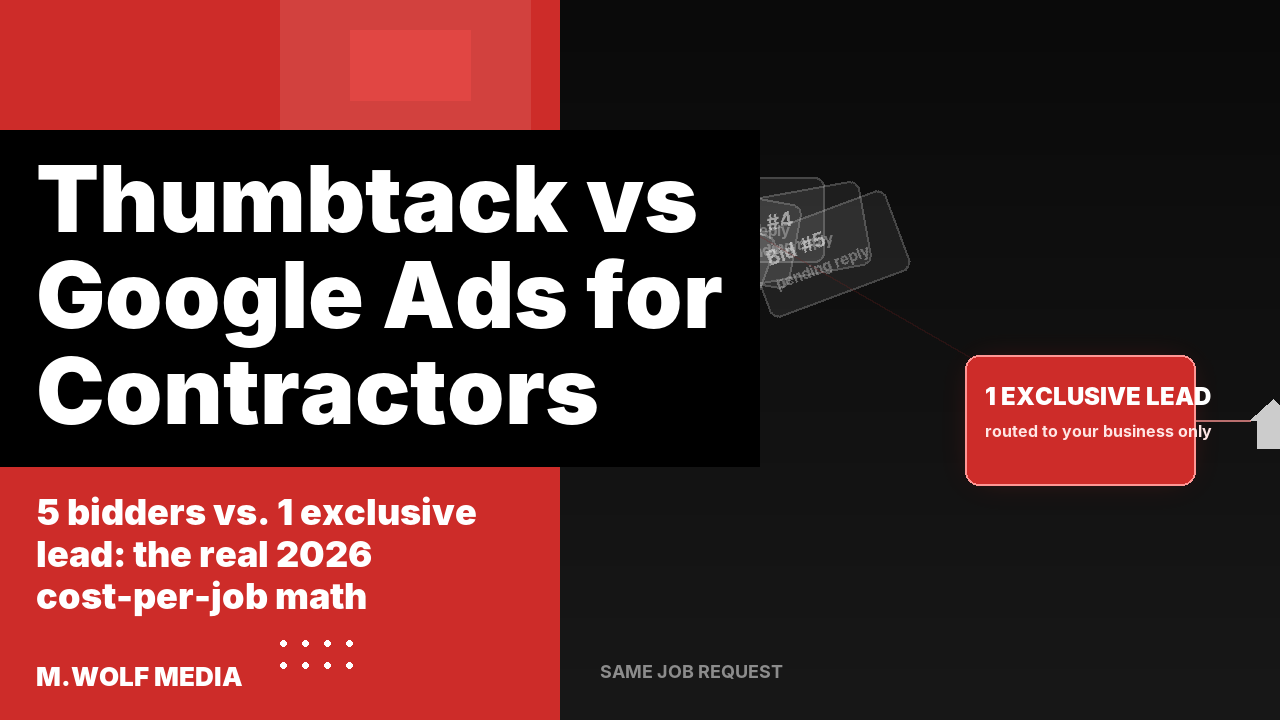
Thumbtack vs Google Ads for Contractors: Why 5 Bidders on One Job Changes the Math
A real cost-per-booked-job comparison for 2026, built from the numbers both platforms actually publish, not the pitch either one gives you at signup.
Ironwood Painting Co. had been running on Thumbtack for two years before the owner finally sat down and added up what every booked job had actually cost. He'd been paying for leads the way most contractors do, a little at a time, a credit here, a few dollars there, never in one lump sum big enough to notice. What he found when he pulled a full quarter of charges into one spreadsheet was a cost per booked job that was embarrassing to say out loud. He wasn't being overcharged. He was paying the going rate. The problem was the going rate for a lead that four or five other painters were also paying for, at the exact same moment, for the exact same homeowner.
That's the part of the Thumbtack vs Google Ads for contractors question most comparisons skip. They line up a per-lead price on each platform, see the numbers land in a similar range, and call it a wash. The actual difference isn't the sticker price of a single lead. It's what happens to that lead the instant a homeowner submits a request, and whether your business is the only one who gets to respond to it.
What follows is the math Ironwood's owner eventually built for himself, backed by the lead-cost and close-rate figures both platforms and the agencies tracking them actually publish: what a Thumbtack lead costs once you count the ones that never reply, what a Google Local Services Ads lead costs by comparison, and what each platform's real cost per booked job looks like once the averages stop hiding behind a single, misleading per-lead price tag.
How Thumbtack's Bidding Model Actually Works
Thumbtack is built as a pay-per-lead marketplace. A homeowner fills out one request describing their job, and the platform matches it to a set of pros in the area, either automatically or after the pro reviews and chooses to pursue it. Either way, you're charged for accessing that contact, whether or not the homeowner ever responds again. That's the mechanic most new users don't fully register until a few months of invoices stack up: the charge happens at contact, not at close.
The part that changes the whole calculation is who else is looking at that same request. A platform comparison guide breaking down Thumbtack vs. Angi puts the number at 3 to 5 pros contacted per homeowner inquiry under the platform's standard matching. A separate discussion among Thumbtack pros on the company's own community forum describes customers currently able to reach out to 7 to 8 pros at once, and some contractors in that same thread report being one of as many as 15 bidders charged for a single job. The exact number moves around by trade, market, and how a given homeowner uses the request form. The pattern holds everywhere. You are very rarely the only business paying for that lead.
A lead that five other contractors are also bidding on isn't a lead. It's a race, and the prize is a job you still have to out-quote four competitors to win. Mitchell Wolfert, Founder, M.Wolf Media
None of this makes Thumbtack worthless. For a contractor with slow weeks and spare capacity, a shared lead that costs $10 to $50 and converts even one time in ten is still a profitable use of an otherwise idle afternoon. The problem shows up when a business tries to build its entire pipeline on a channel where the platform's business model depends on selling the same demand signal to as many paying pros as the local market will support.
What a Thumbtack Lead Costs Once You Count the Losses
The advertised per-lead price is only half the real cost. Reported Thumbtack lead costs range from $10 to over $100 depending on trade, job size, and local competition. Home-improvement contact fees commonly land in the $10-to-$50 band. Larger remodel-style requests run higher. On its own, that number doesn't look dramatically different from what a Google Ads or Local Services Ads lead costs. The difference shows up in what happens after the charge hits your card.
Industry comparison guides put the real close rate on paid Thumbtack contacts at roughly 5 to 15%, a figure that accounts for the share of paid contacts, estimated at 30 to 50% in some reporting, that never get a reply from the homeowner at all. Run that close rate against the lead cost, and the actual cost per booked job lands in a wide $200 to $2,000-plus range depending on trade and market. That's not the $10 to $50 figure on the invoice. It's not a platform being dishonest, either. It's simply what a shared-bid model does to the math once you stop measuring cost per contact and start measuring cost per job that actually gets booked.
"Every contractor I've worked with who tracks Thumbtack honestly ends up doing the same thing: dividing total monthly spend by booked jobs, not by leads purchased. That's the number that matters, and it's almost always worse than the per-lead price led them to expect going in."
Thumbtack: avg. lead cost $10-$100 · documented close rate 5-15% · real cost per booked job $200-$2,000+
Google Local Services Ads: avg. lead cost $25-$130 · documented close rate 25-45% · real-world example cost per booked job ~$160
Net effect: the booked-job cost gap is far wider than the per-lead price gap, because LSA's close rate runs roughly 2-3x higher
The Google Local Services Ads Side of the Same Math
Local Services Ads work on a different structure entirely. Instead of one request form broadcasting to a batch of matched pros, a homeowner searching for a local service sees a ranked list of Google-verified businesses, each carrying the "Google Guaranteed" badge once background-checked and insured, and they choose who to call or message directly off that list. You're charged per valid lead, generally a call or message that reaches your business, not per homeowner who happened to see your listing alongside several competitors.
Published LSA lead costs run $25 to $130-plus per lead depending on trade and market, which on paper sits close to or even above Thumbtack's range. One widely cited real-world example puts it plainly: at a $50 lead cost and a 31% close rate, cost per booked job lands around $160, a figure that's profitable for most trades. That 31% close rate is the number that does the real work in that math. It's roughly double to triple what Thumbtack's shared-bid model documents. It's the direct result of the homeowner choosing your business specifically rather than blasting the same request to a batch of competitors first.
The by-trade numbers tell the same story
Benchmarks broken out by trade back this up with more granular detail. A Feb 2026 analysis of Local Services Ads spend across home service categories, roughly $6.72M in tracked spend across 888 contractors generating 126,650 leads, puts the average cost per lead for home services at $53. Cost per acquired customer by trade runs roughly $80-$180 for HVAC, $60-$140 for plumbing, $120-$280 for roofing, and $70-$170 for electrical work. All of those land comfortably inside or near the $160 anchor figure above. All of them are a fraction of Thumbtack's documented $200-$2,000-plus range.
The two platforms aren't really competing on lead price. They're competing on what happens the moment a homeowner hits submit, whether that request goes to one business or to everyone willing to pay for it. Mitchell Wolfert, Founder, M.Wolf Media
Google also runs a dispute process for leads that shouldn't have been charged in the first place, invalid phone numbers, out-of-service-area requests, or clear spam, which gives a business some recourse that a flat per-contact charge on a shared-bid platform doesn't offer in the same way. It doesn't eliminate every bad lead, but it means the charge isn't purely "you paid, good luck" the way a Thumbtack contact fee can feel once a homeowner goes silent.
| What actually happens | Thumbtack | Google Local Services Ads |
|---|---|---|
| Who sees the homeowner's request | 3 to 15 competing pros, per community and comparison reports | The homeowner browses ranked, verified profiles and picks who to contact |
| Charged even if the lead never replies | Yes, charged at contact regardless of response | Charged for a valid lead; disputable if invalid |
| Documented close rate | 5-15% | 25-45% |
| Reported lead cost range | $10-$100+ | $25-$130+ |
| Real cost per booked job | $200-$2,000+ | ~$160 (example), $60-$280 by trade |
| Verification badge shown to homeowner | Profile reviews only | Google Guaranteed / Google Screened |
Why "Exclusive" Beats "Cheaper Per Lead" Once You See Both Numbers
It's tempting to read a $10 Thumbtack lead against a $50 LSA lead and assume Thumbtack wins on price. That comparison only holds if every lead on both platforms converts at the same rate. They don't. A $10 lead that closes 1 time in 15 costs $150 per booked job before accounting for the contacts that silently vanish. A $50 LSA lead that closes roughly 1 time in 3 costs $160. It also arrived without four or five other contractors also quoting the same homeowner in the same hour. The raw per-lead price is the least useful number either platform publishes.
For Ironwood Painting Co., the fix wasn't dropping Thumbtack entirely overnight. It was running both platforms at once. Thumbtack filled genuinely slow weeks with spare crew capacity. Meanwhile, a Local Services Ads profile built up the reviews and the Google Guaranteed badge that make a homeowner pick one business off the ranked list, without needing to also submit a request to four competitors first. Within a few months, LSA was producing more booked jobs than Thumbtack at a lower real cost per job. The Thumbtack spend shrank down to cover only the weeks LSA volume alone didn't fill.
Getting started on Local Services Ads takes real setup work, a background check, license and insurance verification, and a review history that doesn't exist on day one. That's a longer runway than signing up for Thumbtack, which is exactly why most contractors who eventually make the switch run both platforms side by side during the transition rather than cutting off shared leads before the exclusive channel has enough reviews and ranking history to carry the pipeline alone.
FAQ: Thumbtack vs Google Ads for Contractors
Is Thumbtack or Google Ads cheaper for contractors?
Per-lead price alone makes Thumbtack look cheaper, with reported costs of $10 to $100-plus versus $25 to $130-plus for Google Local Services Ads. Once you factor in close rate, the comparison flips. Thumbtack's documented 5-15% close rate on shared, broadcast leads pushes its real cost per booked job to $200-$2,000-plus, while LSA's 25-45% close rate on exclusive, homeowner-chosen leads puts a real-world example at roughly $160 per booked job.
How many contractors see the same Thumbtack job request?
Reports vary by trade and market, but a platform comparison guide puts the standard figure at 3 to 5 pros contacted per request, Thumbtack's own community forum describes customers currently able to reach 7 to 8 pros at once, and some contractors report being one of as many as 15 bidders charged for a single job. It is rarely, if ever, just you.
Does Google Local Services Ads charge for leads that never turn into a job?
LSA charges for valid leads, generally a call or message that reaches your business, and Google runs a dispute process for leads that shouldn't have been charged, such as invalid phone numbers, requests from outside your service area, or clear spam. Thumbtack, by contrast, charges at the point of contact regardless of whether the homeowner ever replies again.
What's a realistic cost per booked job on each platform?
For Thumbtack, published benchmarks put real cost per booked job at roughly $200 to $2,000-plus depending on trade and market, once you account for the share of paid contacts that never reply. For Google Local Services Ads, one widely cited example lands at roughly $160 at a $50 lead cost and 31% close rate, with by-trade figures running $60 to $280 depending on category.
Can a contractor run Thumbtack and Google Local Services Ads at the same time?
Yes, and most contractors who eventually shift their budget toward LSA run both during the transition. Thumbtack can fill genuinely slow weeks with spare capacity while an LSA profile builds the background check, license and insurance verification, and review history it needs before it can carry the pipeline on its own.
How do I get started on Google Local Services Ads if I've only used Thumbtack before?
Set up a Local Services Ads profile for your trade and service area, complete Google's background check and license/insurance verification to earn the Google Guaranteed badge, and start collecting reviews from recent jobs, since review volume and quality directly affect your ranking position in the homeowner's list. Expect several weeks of setup before lead volume ramps up to match an established Thumbtack account.
Keep Reading: More Lead-Channel Breakdowns
Tired of bidding against four other pros for the same job?
We'll show you what a Local Services Ads profile would realistically cost for your trade and service area, and send back a free 2026 plan to get it running.
Get my free LSA plan