
Google Ads · Fencing · Lead Generation
9 min read
Google Ads for Fence Companies: What Actually Gets You Leads in 2026
Real CPL numbers, campaign structure, and the seasonal timing most contractors miss.
If you run a fence company and you have tried Google Ads, there is a good chance you remember watching money leave your account faster than jobs were coming in. That is almost never a platform problem. It is a structure problem.
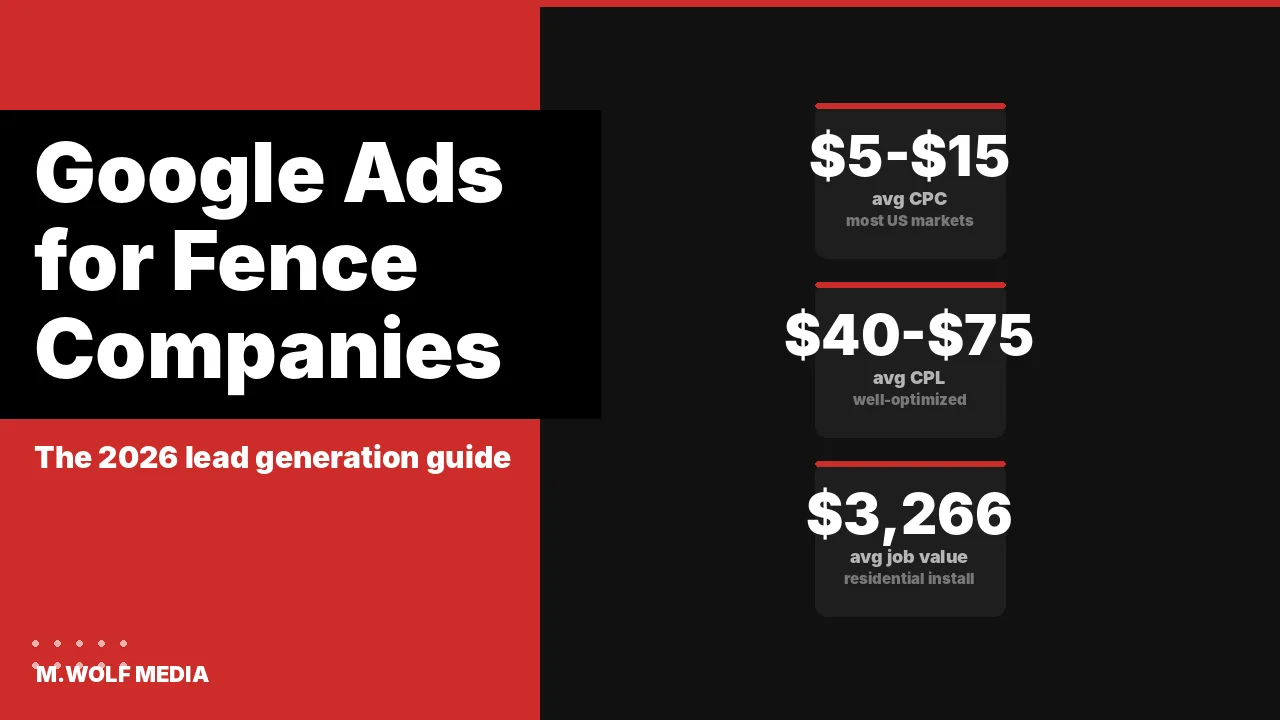
The fencing vertical is actually one of the better trades to advertise on Google. Average CPC is lower than HVAC or roofing, average job value sits around $3,266 nationally, and anyone searching “fence installation near me” has already decided they want it done professionally. The intent is there. The challenge is not capturing demand, it is not bleeding your budget on bad keywords and sending clicks to the wrong page.
This guide covers what it actually costs to run Google Ads for a fence company in 2026, how to structure your campaigns so every dollar works, and how to use Local Service Ads alongside your search campaigns to own more of the SERP without doubling your budget.
💵 Part One: What Google Ads Actually Costs for Fence Companies
The cost of Google Ads for fence contractors depends on three things: your market, your keywords, and how well your campaigns are set up. Get those right and you can generate leads at $40 to $75 each. Get them wrong and you will hit $150 to $200 per lead while wondering if the platform works at all.
CPC by market type
In most suburban markets, high-intent fencing keywords cost $5 to $15 per click. Terms like “fence installation near me,” “wood fence contractor,” and “vinyl fence quote” tend to sit in this range. In dense metros where multiple established fence companies are bidding aggressively, the same terms can push $15 to $40 per click.
The LocaliQ 2025 home services benchmark study puts the broader Construction and Contractors category at $5.31 average CPC across 3,211 US campaigns. Fence-specific, high-intent terms run higher than that average because the buyer is further along in the decision process.
| Market Type | Typical CPC Range | Example Keywords |
|---|---|---|
| Suburban / mid-size metro | $5 – $15 | “fence installation near me,” “wood fence quote” |
| Competitive large metro | $15 – $40 | “fence company [city],” “privacy fence contractor” |
| Emergency / repair terms | $3 – $8 | “fence repair near me,” “storm fence repair” |
| Material-specific | $4 – $12 | “vinyl fence installer,” “chain link fence contractor” |
The real cost per lead math
At $10 CPC and a 12% conversion rate on a well-built landing page, your cost per lead works out to about $83. Tighten the conversion rate to 15% on a dedicated service page and you are at $67 per lead. That math is why landing page quality matters as much as bid strategy.
“The fence contractors generating the most consistent leads are not spending the most. They are spending on the right keywords with the right landing page behind them.”
Mitchell Wolfert, M.Wolf Media
What a realistic monthly budget looks like
A fence contractor covering a single metro or service radius of 20 to 30 miles can generate 8 to 15 qualified leads per month on a $1,500 to $2,500 monthly budget during peak season. Here is how the math scales:
| Monthly Budget | Est. Leads (peak season) | At 20% Close Rate | Revenue Potential |
|---|---|---|---|
| $1,500 | 15 – 25 | 3 – 5 jobs | $9,800 – $16,300 |
| $2,500 | 25 – 40 | 5 – 8 jobs | $16,300 – $26,100 |
| $4,000 | 40 – 65 | 8 – 13 jobs | $26,100 – $42,500 |
These numbers assume a $65 average CPL and $3,266 average job value. Your actual numbers will vary based on market, close rate, and how competitive the auction is in your area. The point is not the exact figure, it is the shape of the return. Fence installs are high enough in value that even a modest lead volume at a reasonable CPL produces strong ROI.
Seasonal timing is where most fence contractors leave money behind
Fencing searches spike 65 to 75% from March through July compared to the off-season baseline. Most contractors respond to this by ramping up ad spend in April or May, which is exactly when their competitors are doing the same thing, driving CPCs up. The contractors who win the season are the ones who launch campaigns in February, before the auction heats up, and capture planning-phase homeowners at lower CPCs before the spring rush begins.
In storm-prone regions, repair keyword spikes happen immediately after major weather events. Having a live campaign with repair ad groups already set up means you can capture that emergency demand in hours rather than days.
🏗 Part Two: Campaign Structure That Actually Converts
Most fence contractor Google Ads accounts fail for one of three reasons: they use broad match keywords without a negative list, they send all traffic to the homepage, or they run every service type inside one campaign with a single bid. All three problems are fixable and fixing them is usually worth more than increasing budget.
The right campaign structure
Separate your campaigns by service type so you control bids and budgets at the right level of granularity:
- Campaign 1: New Installation, wood, vinyl, aluminum, privacy fence. High CPCs, highest job value, most budget here.
- Campaign 2: Fence Repair, storm damage, fence post replacement, gate repair. Lower CPCs, faster close cycle.
- Campaign 3: Commercial Fencing, only if you pursue commercial work. Separate budget, separate landing page, different ad copy.
Within each campaign, group by material or keyword theme. Your wood fence ad group runs wood-specific keywords, your vinyl ad group runs vinyl-specific keywords. Each ad group points to a landing page that matches the query. That match between keyword, ad, and page is what drives quality scores down and conversion rates up.
The negative keyword list fence companies need
Without a negative keyword list, broad match will drain your budget on searches that have nothing to do with your business. The most common offenders:
| Category | Terms to Negative Match |
|---|---|
| Wrong industry | fencing sport, fencing sword, fencing lessons, fencing competition, epee, foil |
| DIY intent | DIY fence, fence panels home depot, fence posts lowes, fence materials, how to build a fence |
| Paint and finish | fence paint, fence stain, fence sealer, fence staining |
| Job seekers | fence jobs, fence installer jobs, fencing career, fence company hiring |
| Supply only | fence supplies, buy fence, fence wholesale, fence manufacturer |
Agency data across multiple fence accounts consistently shows 20 to 40% of ad spend going to irrelevant queries before negatives are built out. That is wasted money that could be going toward actual installation leads.
Landing page requirements for fence ads
Every service-specific campaign needs its own landing page, not the homepage. A homeowner who clicked on a “wood fence installation” ad expects to land on a page about wood fences with a quote form above the fold. Sending them to a homepage with navigation, a company history, and five different services dilutes the conversion rate significantly.
The landing page needs to answer three questions in the first five seconds: What do you do? Where do you do it? How do I get a quote? Everything else is secondary.
“Dedicated service landing pages convert 2 to 3x better than homepages for fencing PPC traffic. The campaign structure gets you the click. The landing page gets you the lead.”
Mitchell Wolfert, M.Wolf Media
Match types and bidding
Start with phrase match and exact match keywords. Broad match without a deep negative list will generate irrelevant traffic early in the campaign before Google has enough conversion data to understand your audience. Once you have 30 to 50 conversions tracked, you can test broad match selectively with Smart Bidding.
For bidding strategy, use Manual CPC or Maximize Clicks to start until you have conversion data. Once you hit 30+ conversions per month, switch to Target CPA (set your target at 20 to 30% above your current CPL to give the algorithm room to learn). Target ROAS requires more data and is better suited for fence companies with a wide range of job sizes where you can track job value.
Conversion tracking is not optional
Set up conversion tracking for phone calls (minimum 60-second calls), form submissions, and quote requests. Without conversion data, you are flying blind. Google’s algorithm cannot optimize toward your best-performing keywords if it does not know which keywords are actually generating calls. This is the single most common missing piece in fence contractor accounts we audit.
📱 Part Three: Local Service Ads vs. Google Search Ads for Fence Companies
Fence companies are eligible for Local Service Ads (LSAs) and most are not running them. That is a missed opportunity because LSAs appear above Google Search Ads in the SERP, carry the Google Guarantee badge, and operate on a pay-per-lead model instead of pay-per-click.
How LSAs work for fence contractors
LSAs are Google’s lead-generation product for local service businesses. You pay only when a homeowner contacts you through the ad, not when they click. Google verifies your business through a background check, license verification, and your Google Business Profile before you can run them.
Eligible fence categories include: fence installation, wood fence, vinyl fence, chain link, aluminum and ornamental fencing, fence repair, and gate installation. You choose which job types you want to show for and set a weekly budget cap.
| Google Search Ads | Local Service Ads | |
|---|---|---|
| Position on SERP | Below LSAs | Top of page (above Search Ads) |
| Billing model | Pay per click | Pay per lead |
| Avg CPL | $40 – $75 | $25 – $65 |
| Conversion rate | 6 – 15% | 20 – 25% |
| Control | Full keyword/bid control | Limited (Google handles matching) |
| Google Guarantee badge | No | Yes |
| Best for | Specific service targeting | Brand trust, local presence |
Should you run both?
Yes, and almost every fencing-specific marketing agency with published data says so. LSAs and Search Ads target different moments in the search experience and occupy different positions on the results page. A fence company running both owns more of the visible SERP than one running only Search Ads.
The Google Guarantee badge in LSA results also provides social proof that a standard Search Ad does not carry. Homeowners who see the badge understand that Google has verified the business. That reduces the friction between “I clicked the ad” and “I submitted my information.”
Practical setup for running both
Allocate 30 to 40% of your total Google budget to LSAs and 60 to 70% to Search Ads as a starting point. Adjust based on actual CPL from each source over the first 60 to 90 days. You may find that LSAs drive your lowest CPL, in which case you shift more budget there. Or you may find that Search Ads convert at a higher job value because you can control the keywords more precisely. Let the data tell you.
To qualify for LSAs you need a verified Google Business Profile, a passing background check, proof of general liability insurance, and a clean review profile. The review count on your GBP directly affects your LSA ranking. Fence contractors with 40+ reviews tend to show more often and at a lower CPL than those with 10 or fewer.
The US fencing market is a $9.33 billion industry growing at 5.3% annually, with professional installation capturing 68% of that revenue as more homeowners choose to hire out rather than DIY. The demand is there. The contractors who win it in the next two years are the ones who get their Google presence right before the auction gets more competitive.
Check Google’s Local Services Ads page for current eligibility requirements in your area, since categories and coverage continue to expand.
Frequently asked questions
How much should a fence company spend on Google Ads per month?
A fence company covering a single metro area typically sees solid lead volume on $1,500 to $2,500 per month during peak season (March through July). Contractors covering larger service areas or multiple markets often spend $3,000 to $5,000 per month. Start at a level you are comfortable testing for 60 to 90 days and scale based on your cost per lead and job close rate.
What keywords work best for fence company Google Ads?
High-intent installation terms perform best: ‘fence installation near me,’ ‘fence contractor [city],’ ‘wood fence installation,’ ‘vinyl fence quote.’ Material-specific terms (vinyl, wood, aluminum, chain link) also perform well because they signal a buyer who has already decided on the material. Build a strong negative keyword list from day one to block DIY, fencing sport, and supply-only searches.
What is a good cost per lead for a fence contractor?
A well-optimized fence campaign in most suburban markets should produce leads at $40 to $75 during peak season. If your CPL is over $100 in spring or summer, it usually means one of three things: broad match keywords burning budget on irrelevant searches, traffic going to a homepage instead of a service-specific landing page, or geographic targeting that is too wide for your actual service area.
Are Local Service Ads worth it for fence companies?
Yes. Fence contractors are fully eligible for LSAs, which appear above standard Google Search Ads and operate on a pay-per-lead model. Average CPL through LSAs runs $25 to $65 for fencing. Running LSAs alongside Search Ads lets you occupy two distinct positions on the SERP and carry the Google Guarantee badge, which increases consumer trust before a homeowner even clicks.
When is the best time to run Google Ads for a fence company?
Year-round, but with higher budgets from March through July when installation demand peaks. The smart play is to launch or ramp up campaigns in February, before the April surge when competitors re-enter the auction and push CPCs up. Keep campaigns live at a reduced budget in winter to maintain Google’s algorithm learning data and capture planners who start researching early.
Do Google Ads work for fence repair as well as new installations?
Yes, and repair keywords are often a better starting point because CPCs run lower ($3 to $8 vs. $5 to $15 for installation terms) and the close cycle is faster. A homeowner with a storm-damaged fence needs it fixed soon. Separate your repair campaign from your installation campaign so you can bid and budget them independently.
Keep reading
Ready to get more leads from Google?
Tell us about your current setup and we will show you exactly where to start.