
Google Ads
9 min read
Google Ads
Google Ads for Roofers: Budget, CPL, and What a Real Campaign Costs in 2026
The exact numbers, campaign structure, and budget tiers we use to generate qualified roofing leads from Google Ads. No filler. Just what works.
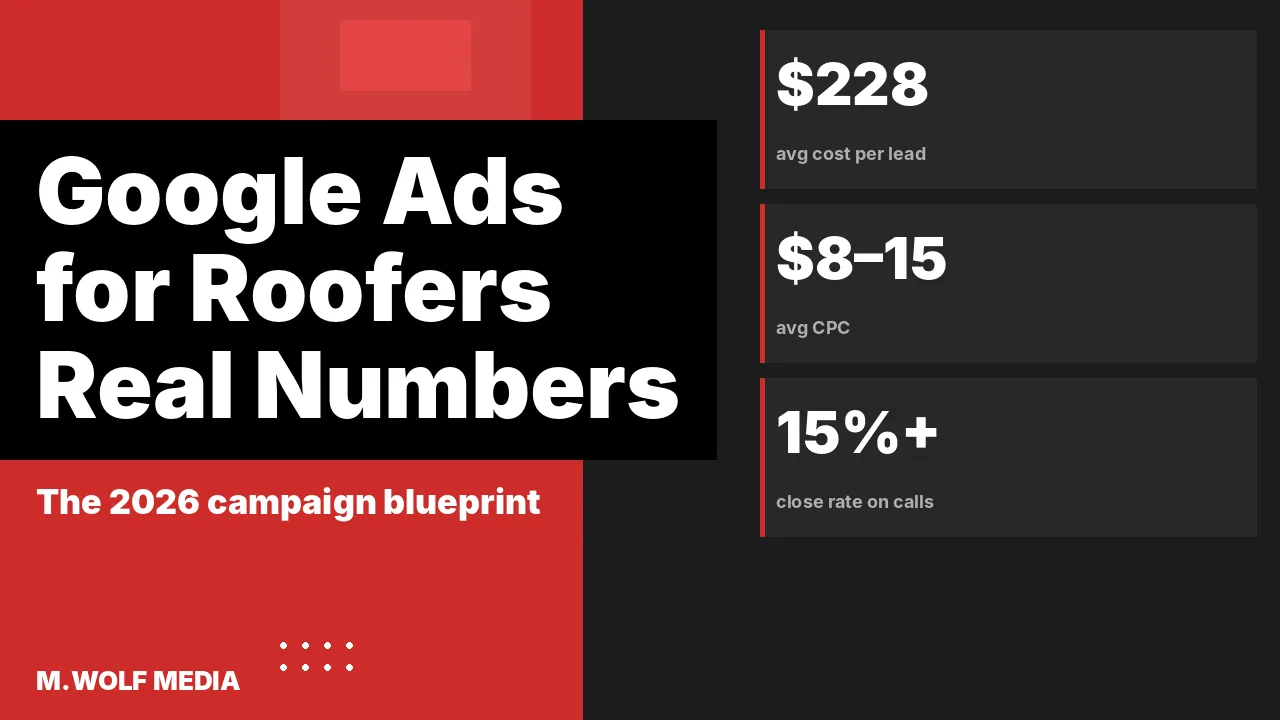
- Average cost per lead for roofing Google Ads is $228 nationally. In competitive storm markets it can run $300 or higher.
- Average CPC for roofing keywords ranges from $8 to $15. Emergency and storm-specific terms push toward the high end.
- Roofing campaigns need three separate ad groups: storm/hail damage, full replacement, and repair. Each has different intent and different close rates.
- Local Services Ads should run alongside Search Ads for roofers, not instead of them. Both together give you double page-one coverage.
If you run a roofing company and you have ever asked whether Google Ads are worth it, you already know the short answer is yes. Roofing is one of the highest-CPL verticals in home services, and every time you are not on page one, you are handing that job to a competitor who is. The question is not whether to run Google Ads for roofers. The question is how to run them without burning through $3,000 a month with nothing to show for it.
This post covers the actual cost data, the campaign structure that works for roofing specifically, and the difference between Local Services Ads and regular Google Search Ads so you can decide where to put your money first.
Part One: What Google Ads Actually Costs for Roofing Companies
Most roofing contractors get sticker shock the first time they see roofing keyword CPCs. At $8 to $15 per click, a single day of moderate traffic can cost more than a dinner for the whole crew. But the number that matters is not CPC. It is cost per booked job, and that math looks very different.
The real cost breakdown
Here is how the numbers chain together on a typical roofing Google Ads account:
| Metric | Strong | Average | Needs Work |
|---|---|---|---|
| CPC (cost per click) | $8–12 | $12–18 | >$22 |
| Landing page CVR | 12–18% | 6–12% | <4% |
| Cost per lead | $80–150 | $150–280 | >$350 |
| Close rate (on calls) | 20–35% | 12–20% | <8% |
| Cost per closed job | $300–600 | $700–1,400 | >$2,000 |
On a $12,000 average roofing job, even a $1,000 cost per closed job is a 12:1 return on ad spend. That is why roofing contractors who build a working Google Ads campaign do not stop. The margin is there. The challenge is getting the structure right so you are not at $2,000 per closed job while you figure it out.
“The biggest mistake roofers make is running one broad campaign that tries to cover storm damage, replacement quotes, and repair calls with the same ads and the same landing page. Those are three completely different buyers.”
Mitchell Wolfert, M.Wolf Media
Budget tiers by company size
Here is how to think about minimum viable spend for a roofing company, scaled by fleet size and service area:
- Single crew, local market (1 city or county): $2,000–$3,500 per month. This gets you enough daily budget to stay competitive on your best 10–15 keywords during business hours. Expect 8–20 leads per month at this level in most markets.
- 2–4 crews, multi-city coverage: $4,000–$8,000 per month. You need enough budget to run separate campaigns for each service area without throttling. Below this, you will hit daily budget caps before noon on busy days.
- Regional operation, 5+ crews: $8,000–$20,000+ per month. At this scale, the campaign structure and conversion tracking are more important than raw budget. You should also be running Local Services Ads in parallel.
A rule of thumb: your monthly Google Ads budget should be able to generate at least 3–5 booked jobs to justify the spend. Work backwards from your CPL and close rate to find your floor. If your average CPL is $200 and your close rate is 20%, you need $1,000 in spend for every booked job. A 3-job minimum means $3,000 per month as your baseline.
Storm season vs. steady state
Roofing is the most seasonally volatile trade in Google Ads. A single hail event can 10x your impression volume overnight and cut your CPL in half. Your campaign structure needs to handle both states without you rebuilding it every spring.
The practical answer: run a base campaign year-round at a sustainable budget with your core replacement and repair keywords. Add a separate storm campaign that stays paused and can be activated within 24 hours of a weather event. The storm campaign uses higher bids, weather-responsive ad copy, and a landing page that specifically addresses storm-damage inspections. When it activates, it does not disrupt your base campaign budget or quality score history.
Part Two: Campaign Structure for Roofing Google Ads
Roofing has three distinct buyer types, and they each need their own campaign. Mixing them creates a structural problem where your ads, landing pages, and conversion goals are all misaligned with what each searcher actually wants.
The three-campaign framework
Campaign 1: Storm and Hail Damage. This is your highest-urgency buyer. They just had a weather event, their roof may be damaged, and they need an inspection fast. Keywords: “hail damage roof inspection,” “storm damage roofer [city],” “free roof inspection after storm.” Bid strategy: Target CPA or Maximize Conversions with a goal of free inspection scheduled. Landing page: lead directly with the free inspection offer and a short form. No price talk. No upsell. Just the inspection CTA.
Campaign 2: Full Replacement. This is your highest-ticket buyer. They know they need a new roof, they are comparing companies, and they are going to get 2–3 quotes. Keywords: “roof replacement [city],” “new roof cost [city],” “roofing companies [city].” Bid strategy: Target Impression Share at 65–80% for top-of-page to stay visible during the comparison window. Landing page: before/after photos, financing options, warranty details, and a quote request form. This buyer takes longer to close but is worth $12,000+ per job.
Campaign 3: Repair. This is your volume-driver. Lower ticket ($500–$2,500 per job) but higher close rate and faster sales cycle. Keywords: “roof leak repair [city],” “fix roof leak [city],” “roof repair near me.” Bid strategy: Maximize Conversions with phone call as primary goal. Landing page: short, fast-loading, phone number prominent above the fold.
Keyword match type strategy for roofing
Start with exact match on your best 10–15 terms. Add phrase match after 30 days of data to expand reach. Avoid broad match until you have strong negative keyword lists built from real search term data.
Your negative keyword list for roofing should include at minimum: “DIY,” “how to,” “cost of,” “price of” (unless you have a cost-focused landing page), “jobs,” “careers,” “hiring,” “roofing supplies,” “metal roofing sheets,” “flat roof material.” These pull in homeowners who are not yet buyers or people looking for completely different things.
“We had one account spending 40% of its budget on people searching for roofing nails and contractor licensing tests. A one-hour negative keyword audit cut CPL by 35% without touching bids.”
Mitchell Wolfert, M.Wolf Media
Ad copy that converts for roofing
Your ad needs to answer three questions in under 3 seconds: who you are, what you do, and why they should call you instead of the next result. For roofing, the highest-performing ad elements we see consistently are:
- License and insurance mention in the description (builds trust fast)
- Free inspection or free estimate in the headline
- Local city name in at least one headline
- Response time promise if you can back it up (“Same-day inspections available”)
- Years in business if it is 10 or more
Use responsive search ads with at least 10 headlines and 4 descriptions. Let Google test combinations for 4–6 weeks before you start pinning specific headlines. The system will find combinations that perform better than anything you would have chosen manually.
For a full breakdown of how to compare Google Ads against the other paid channel most roofers consider, our Facebook Ads vs Google Ads for contractors guide walks through which platform wins for roofing specifically and why.
Part Three: Local Services Ads vs. Google Search Ads for Roofers
If you have ever wondered whether to run Local Services Ads (LSAs) or regular Google Search Ads, the honest answer is: both. They appear in different positions on the page and they work differently. Running one does not replace the other.
How LSAs work for roofing
Local Services Ads appear at the very top of Google, above regular Search Ads. Google’s Local Services Ads program is designed specifically for service businesses that need to verify their license and insurance before running ads. They show your Google Guaranteed badge, star rating, years in business, and a click-to-call button. You pay per lead, not per click. Google qualifies the leads based on the services you list and your service area. You can dispute leads that do not match your criteria.
For roofing, LSAs work especially well for repair and inspection calls where the buyer wants a fast, local, trusted company. The Google Guaranteed badge does the heavy lifting on trust. LSA CPLs for roofing typically run $40–$120, which is significantly lower than Search Ads. The tradeoff is volume. Most markets cap out at 10–30 LSA leads per month regardless of how much you are willing to spend. That ceiling is the reason you still need Search Ads for scale.
Where Search Ads outperform LSAs
Search Ads give you full control over keywords, ad copy, landing page experience, and budget scaling. There is no lead volume ceiling. If you want 100 leads per month, you can buy 100 leads per month, provided your budget and bid strategy support it. Search Ads also give you attribution data: you can see exactly which search terms, devices, times of day, and geographic areas are producing your best leads. LSAs give you almost none of that transparency.
The combined strategy: use LSAs to capture the trust-driven, high-intent buyers at the top of the page. Use Search Ads to cover the full keyword landscape, scale volume, and run specific campaigns for replacement, storm damage, and repair separately. Together, they give you two positions on page one, which materially increases your market share in any given search.
What to track and when to optimize
Roofing campaigns need at least 30 days of data before you make structural changes. The roofing sales cycle is long enough that week-one CPL numbers are almost meaningless. A lead that calls on week one may not sign a contract until week three. Set your attribution window to 30 days, not the default 7.
The metrics to review weekly: impression share, average CPC, conversion rate by campaign, cost per lead by campaign. Monthly: cost per closed job by campaign (this requires your CRM or a simple spreadsheet tracking which calls converted). Quarterly: landing page CVR, ad headline performance (through the RSA asset report), and negative keyword list expansion.
If your campaigns are running but your CPL is above $300 and not improving, the root cause is almost always one of three things: landing page that does not match search intent, keywords that are too broad, or no negative keyword list. Our Google Ads troubleshooting guide walks through a 7-step diagnostic for exactly this situation. And if you want to see what realistic Google Ads budgets and CPLs look like across other home service trades, our Google Ads cost guide for home service businesses has the full trade-by-trade breakdown.
The roofers who build reliable Google Ads pipelines are not doing anything exotic. They have clean campaign structure, a fast landing page, and they check their search term report weekly to add negatives. That discipline compounds. A campaign that was generating $280 CPL in month one will often be at $140 CPL by month four with no budget increase, just ongoing refinement.
Frequently asked questions
How much should a roofing company spend on Google Ads?
For a single-crew operation covering one city, $2,000 to $3,500 per month is a realistic starting point. Multi-crew regional companies typically spend $5,000 to $15,000 per month. The right number depends on your local CPC, service area size, and how many jobs you can actually handle. Start at a level you can sustain for 60 days without expecting immediate profitability. Most roofing campaigns reach efficient CPL around month three.
What is a good cost per lead for roofing Google Ads?
The national industry average is around $228 per lead. Strong-performing accounts hit $80 to $150. If your CPL is consistently above $300 and not improving, the issue is almost always structural: either your keywords are too broad, your landing page is mismatched to search intent, or you have no negative keyword list. The CPL target that makes sense for your business depends on your average job size and your close rate.
Should roofers use Local Services Ads or Google Search Ads?
Both. Local Services Ads give you the Google Guaranteed badge at the top of the page and a lower CPL ($40 to $120 typically), but they cap out at 10 to 30 leads per month in most markets. Google Search Ads have no volume ceiling, full keyword control, and better attribution data. Running both gives you two positions on page one and covers different buyer behaviors. LSAs are best for fast, local trust signals. Search Ads are best for scale and campaign-level optimization.
How long does it take for Google Ads to work for roofers?
Most roofing campaigns produce their first booked jobs within the first two to three weeks. But efficient CPL, where your campaigns are running well and your cost per closed job is within target, typically arrives around month three. The learning period for Smart Bidding strategies like Target CPA is 30 to 50 conversions, which takes time to accumulate. Avoid making major structural changes before you have meaningful data.
What keywords should roofers target with Google Ads?
Split your keywords by intent. Storm and hail damage: “hail damage roof inspection,” “storm damage roof [city],” “free roof inspection.” Full replacement: “roof replacement [city],” “new roof cost,” “roofing companies [city].” Repair: “roof leak repair,” “fix roof leak [city],” “emergency roofer.” Start with exact match on your best 10 to 15 terms, then expand to phrase match after 30 days. Build your negative keyword list from real search term data in the first two weeks.
Keep reading
Ready to get more roofing leads from Google?
Tell us about your current setup and we will show you exactly where to start.