
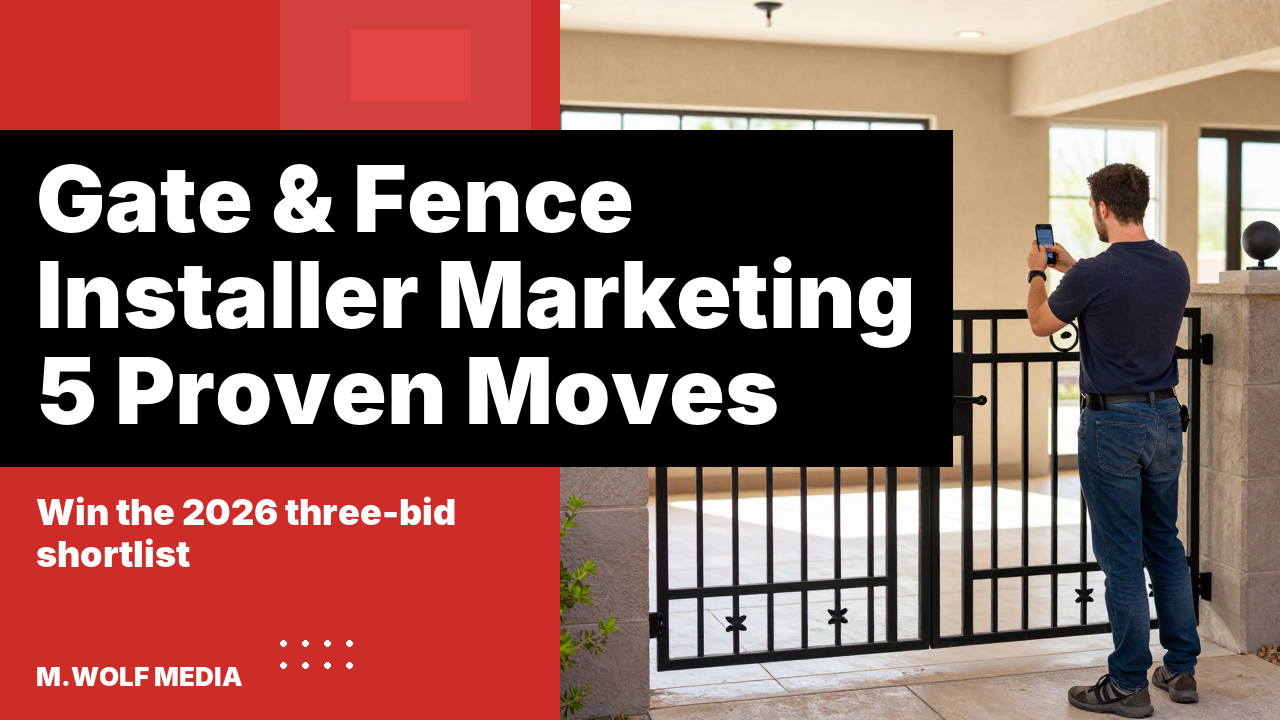
Gate and Fence Installer Marketing: 5 Proven Moves That Win the Bid
How one East Valley gate and fence crew stopped losing five-figure jobs to slower, less impressive competitors, and the exact system that flipped the three-bid shortlist in their favor.
Ironline Gate & Fence had been building custom wrought iron driveway gates and privacy fencing around Gilbert and San Tan Valley for nine years. The work was genuinely good. Ask any of their homeowner clients and you'd hear the same thing: clean welds, real steel instead of hollow tube, a crew that showed up when they said they would. None of that showed up in their close rate. They were losing three out of every four estimates to competitors whose gates, frankly, weren't as well built.
The owner assumed it was price. It wasn't. When we pulled the estimate log, Ironline's bids were landing in the middle of the pack, sometimes lower. Here's what was actually happening. A homeowner would submit a request through three or four companies on the same afternoon. Ironline's callback came a day and a half later. By then the homeowner had already picked someone from the two or three companies that called back within the hour. The job was gone before Ironline's estimator ever picked up the phone. Nobody ever told them that. They just stopped hearing back.
This is the story of what changed, and it's the same fix that applies to almost any gate and fence installer marketing plan that's producing good reviews but not enough signed contracts. Custom gates and fence installs are five-figure purchases sold almost entirely on visual proof and speed of response, not on being the most polished-sounding voicemail message. Fix those two things and the rest of the funnel gets a lot easier to build.
Why Gate and Fence Jobs Are Won on Photos, Not Pitches
A homeowner shopping for a custom driveway gate or a full backyard fence isn't buying a commodity. They're buying something that will sit at the front of their house for the next twenty years, and they have almost no way to judge quality from a phone call alone. What they can judge is a photo. A real before-and-after shot of a comparable iron gate, ornamental fence panel, or automated driveway system does more to close a five-figure estimate than any script an estimator could read off a clipboard.
Ironline had hundreds of good project photos sitting in a personal phone and an Instagram account nobody outside their existing customers ever saw. None of it was doing any selling. The fix wasn't shooting new content, it was routing the photos they already had into the three places that actually influence a buying decision: the Google Business Profile, the Google Ads landing pages split by project type, and the quote itself.
The photo system that actually gets used
The system that stuck was simple enough that a crew lead could run it without being reminded: a phone photo of the finished gate or fence panel before the crew leaves the driveway, in good light, from the angle a homeowner would actually see it from the street. That single habit, applied consistently, is what feeds every other channel below. Google's own research (originally published alongside a 2014 Google/Oxera study, and still widely cited by local-search agencies today) found that business profiles with photos get 42% more requests for directions and 35% more clicks to their website than profiles without them. For a gate and fence installer, whose entire value proposition is visible in a single frame, that gap is likely even wider.
Nobody hires a $14,000 driveway gate off a stock photo and a five-star badge. They hire it off a picture of the exact style, in a yard that looks like theirs, built by the crew that's about to show up at their house. Mitchell Wolfert, Founder, M.Wolf Media
The Three-Bid Shortlist, and Why Speed Wins It
Almost every homeowner shopping for a gate or fence job gets three to four estimates on the same day, usually within hours of each other. That means the deciding factor is rarely price alone. It's whoever shows up on the shortlist first. It's whoever follows up fastest and looks the most credible while doing it. This is the part of gate and fence installer marketing that has nothing to do with ad creative. It's entirely about what happens in the ten minutes after a lead comes in.
Industry lead-response data backs up what we saw in Ironline's estimate log directly: 78% of customers hire the first service provider to respond to their inquiry, not the highest-rated or the lowest-priced. The same research puts the average home service response time at roughly 47 hours, while a response inside 60 seconds converts at up to 391% higher rates than a delayed one. Only about 12% of contractors ever respond inside the first five minutes. That gap is the entire opportunity.
"Every gate and fence company we've worked with thought their close rate problem was pricing. It was almost never pricing. It was the eighteen hours between the form submission and the callback, during which the homeowner had already booked someone else."
Custom Iron Gates campaign: 84 clicks @ $9.10 CPC · form fills 14 · avg. time-to-callback 4 min
Privacy Fencing campaign: 121 clicks @ $6.85 CPC · form fills 19 · avg. time-to-callback 6 min
Estimates booked: 26 of 33 total form fills across both campaigns
Building the Google Ads Funnel That Actually Feeds the Shortlist
Sending gate and fence traffic to a homepage is the single fastest way to burn a budget in this category. A homeowner searching "custom driveway gate installer" pictures a completely different project than one searching "vinyl privacy fence installation." Each has a different price range in mind too. A generic homepage answers neither question in the first five seconds. Our landing page anatomy guide for contractors covers the structure in more depth. For gate and fence specifically, that means separate landing pages by project type. Custom iron gates, automated driveway gates, vinyl or wood privacy fencing, and ornamental or pool-code fencing each get their own page, their own project photos, and their own short quote form.
What the category actually costs to run
Home and home improvement carries one of the higher costs-per-click on Google Search, and gate and fence work sits squarely in that category. The 2026 LocaliQ/WordStream benchmark report, covering more than 13,000 US campaigns, puts the Home & Home Improvement average at $8.33 per click and $90.92 per lead, with a conversion rate right around 8%. Against a five-figure project, a $90 cost per lead is not a rounding error worth worrying about. It's noise, as long as the callback happens inside minutes instead of days.
The quote form itself needs to ask for almost nothing: name, phone, project type, and rough linear footage or gate count if the homeowner happens to know it. Every extra field is a reason to abandon it before submitting, and on a purchase this size, the form's only job is to get a phone number in front of an estimator inside minutes, not to pre-qualify the lead to death.
A $90 lead on a $12,000 gate isn't expensive. A four-hour callback on that same lead is the most expensive thing in the business, because it throws away a job you already paid to win. Mitchell Wolfert, Founder, M.Wolf Media
Turning Google Business Profile Into a Second Landing Page
Paid search wins the shortlist moment. Google Business Profile is what keeps paying off between ad clicks, at no additional cost per lead, and for a visual trade like gate and fence work it functions as a second landing page more than a directory listing. A profile with current project photos, accurate service categories (not just "fence contractor," but the specific gate and iron-work categories that actually match the work), and a steady flow of recent reviews shows up higher in the map pack and converts better once a homeowner clicks through.
Review timing matters more than review count alone. A homeowner who just watched their new gate installed is far more likely to leave a detailed, photo-included review than one contacted a month later after the excitement has worn off. An automated text sent the same day a job wraps captures dramatically more reviews than an in-person ask at the end of a long install day. Our guide to getting Google reviews for contractors walks through the exact system.
| What changed | Old playbook | New playbook |
|---|---|---|
| Lead source | Referrals and truck signage only | Project-specific Google Ads landing pages plus referrals |
| Callback time | 18-36 hours, whenever the estimator had a gap | Under 10 minutes, routed straight to a phone alert |
| Photos | Sitting in a personal phone, rarely posted | Shot on every job, fed into GBP, ads, and quotes weekly |
| Reviews | Asked verbally, inconsistently, weeks after the job | Automated text the day the job wraps |
| Estimate close rate | Roughly 1 in 4 | Better than 1 in 2 within four months |
Timing the push around the two bid-heavy seasons
Gate and fence demand isn't flat across the year. Spring, roughly March through May, brings the first wave: homeowners fixing up yards for the summer and closing on new-build homes that shipped with a bare backyard. A second, smaller wave hits in early fall once temperatures drop enough to make outdoor projects tolerable again. Budgets planned around a flat monthly spend miss both windows. The accounts that perform best shift spend up two to three weeks ahead of each season, so the campaign is already warmed up and ranking in the auction before the search volume actually arrives, rather than reacting to it after competitors have already locked in the top positions.
Automated gate openers and HOA-compliant fencing deserve their own mention here too, since both carry higher average tickets and narrower buyer intent than a standard fence run. A homeowner searching for an automated driveway gate has usually already ruled out a manual one, and a homeowner in an HOA community searching for compliant fencing already knows their options are limited by the association's rules. Both searches convert at a noticeably higher rate than generic fence queries, which makes them worth their own ad group and landing page even at a lower monthly search volume.
None of these four pieces replaces the other three. Photos without a fast callback still lose the shortlist. A fast callback without believable project photos still loses the trust decision. Put together, gate and fence installer marketing stops depending on luck, referral timing, or whichever competitor happened to be slower that week. It starts producing the same result almost every time a homeowner starts typing.
FAQ: Gate and Fence Installer Marketing
What's the fastest way for a gate and fence installer to book more estimates?
Project-specific Google Ads landing pages paired with a callback inside minutes, not hours. Homeowners typically request three to four estimates the same day, and the company that responds first usually wins the job regardless of price.
Why do photos matter so much for gate and fence marketing specifically?
A gate or fence is a highly visible, long-term purchase that a homeowner can judge almost entirely from a photo. Real before-and-after shots of comparable projects do more to justify a five-figure quote than any sales pitch, since there's no other easy way to judge installation quality before hiring.
How much does Google Ads cost for a gate or fence company?
Home and home improvement campaigns typically run around $8 to $9 per click and roughly $90 per lead, per 2026 industry benchmark data. Against a five-figure gate or fence project, that cost per lead is small compared to the value of winning the job.
Should gate and fence installers run separate ads for gates versus fencing?
Yes. Someone searching for a custom driveway gate and someone searching for privacy fencing are picturing different projects and different budgets, so separate campaigns and landing pages built around each project type convert noticeably better than one generic page.
Does Google Business Profile actually matter if a company already runs paid ads?
Yes. Google Business Profile functions like a second landing page that keeps producing map pack visibility and click-throughs at no added cost per lead, and it's often the first thing a homeowner checks after clicking an ad to confirm the company is legitimate.
How fast should a gate or fence installer call back a new lead?
Inside a few minutes whenever possible. Industry data shows leads contacted within 60 seconds convert at dramatically higher rates than delayed callbacks, while the average home service business takes hours to respond, which is exactly the gap a fast callback exploits.
Keep Reading: More Playbooks for Home Service Trades
Ready to win more gate and fence bids?
We'll review your Google Ads setup, landing pages, and Google Business Profile, then send back a free plan built for your gate and fence company. No pitch.
Get my free Google Ads plan