
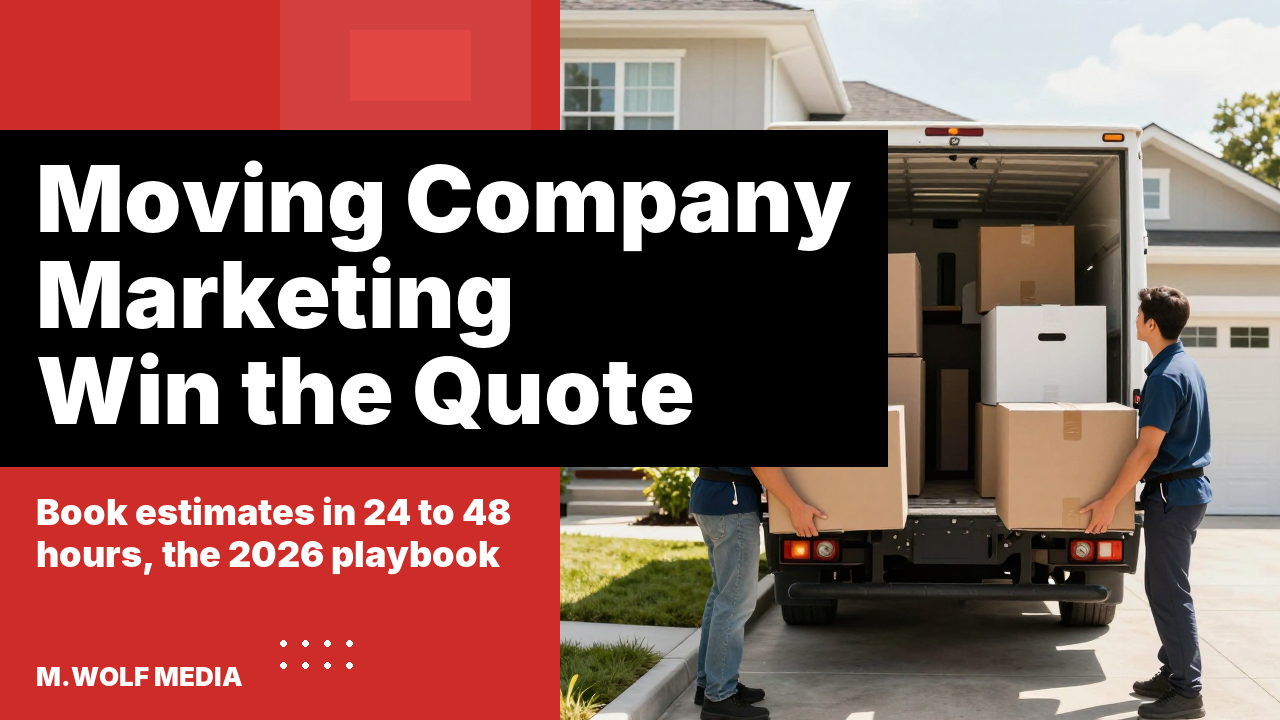
Moving Company Marketing: Win the Three-Quote Afternoon
Most people compare three movers in a single afternoon and book the one that answers first. Here is the funnel that gets your ad in front of them at that exact moment, and turns the click into a booked estimate in 24 to 48 hours instead of a lead you split with four competitors.
Somebody decides to move, opens their phone, and requests quotes from three moving companies in the span of an hour. That is the entire buying window for most residential moves: no multi-week research phase, no vendor shortlist meeting, just a fast round of quote requests squeezed between packing boxes and calling the school district. Whoever calls back first usually wins the job, and price is often the second or third factor, not the first.
That single fact should reshape how a moving company spends its marketing budget. Moving company marketing that treats a lead like a slow-moving B2B opportunity, a nice website, a Facebook page, a "we'll follow up this week" habit, loses to the competitor who shows up in the first three search results and calls back within the hour. This is a speed business wearing a logistics costume.
This guide covers why that three-quote afternoon behaves the way it does. It covers how to build a paid search and fast quote-form funnel that books an estimate in 24 to 48 hours. And it covers why shared lead platforms quietly cost movers more than they appear to save.
Nobody researches a moving company for three weeks. They open five tabs on a Tuesday afternoon, request quotes from all five, and book with whoever calls back before the coffee gets cold.
Why the Three-Quote Afternoon Decides Who Books the Job
Moving is a forced purchase with a hard deadline attached. Nobody moves because they felt like browsing movers, they move because a lease ends, a closing date is set, or a job relocation has a start date. That deadline compresses the entire research and booking process into hours instead of weeks, and it changes which channels and which response habits actually win the job.
The search-then-compare pattern
A person who searches "movers near me" or "moving company [city]" is almost always already in buying mode, not early research mode. They will typically open the map pack, skim ratings, click into two or three sites, and submit a quote request on each within the same sitting. The company that shows up first in that map pack and search results, with a fast-loading quote form, gets first crack at the callback. Everyone else is competing for a customer who has probably already talked to someone else.
What "answering first" actually means
Answering first is not just about being fast on the phone, though that matters enormously. It starts with being visible the moment someone searches. A Local Services Ads badge and a Search ad above the organic results. A Google Business Profile with recent reviews and real photos of trucks and crews. A quote form that loads in under two seconds on a phone with one bar of signal in a half-packed apartment. Every one of those is a place a slow, generic website quietly loses the afternoon.
Reviews are the price of entry, not a nice-to-have
Before a single ad dollar gets spent, the review profile has already decided whether a click converts. Ninety-seven percent of consumers read reviews before picking a local business. For a category built entirely on trust, a stranger's crew touching every possession you own, that number is probably conservative for moving specifically. A four-star profile with 20 recent reviews will out-convert a 4.8-star profile that stopped getting reviews two years ago. Recency reads as "still operating well" just as much as the star count does.
"Movers spend money trying to rank for keywords before they've asked a single happy customer for a review this month. Fix the review flow first. It's the cheapest conversion lift in the entire account, and it makes every dollar you spend on ads afterward convert better."
The Moving Company Marketing Funnel That Books Estimates in 24 to 48 Hours
If the buying window is measured in hours, the funnel has to be built for hours too. That means three pieces working together: paid visibility that shows up the moment someone searches, a quote form fast enough that people actually finish it on a phone, and a follow-up process that treats every submission like it is already being compared against two competitors, because it almost always is.
Local Services Ads plus Search, not one or the other
Google Local Services Ads sit above regular Search ads. They show a Google Screened badge and charge per lead instead of per click, which makes them a strong fit for a category where trust signals matter this much. Search ads still earn their place underneath. They catch branded searches, "near me" variations, and long-tail terms like "same day movers" or "long distance movers [city]" that a fixed LSA category list won't fully cover. Running both together, rather than picking one, covers more of that three-tab research window than either does alone.
A quote form built for a phone in a half-packed kitchen
The most common leak in a moving company's funnel is not the ad, it's the form behind it. A quote request that asks for inventory details, a full address, and move-date flexibility before collecting a name and phone number will lose people who are filling it out one-handed. Ask for the minimum to start a conversation, name, phone, move date, origin and destination city, and move the inventory and full address questions to the callback. Every extra required field before the phone number is a chance to lose the lead to whichever competitor's form loaded faster.
The first-hour callback wins the job
Contacting a lead within five minutes instead of thirty makes it roughly 21 times more likely to qualify. That is according to the MIT/InsideSales.com Lead Response Management study of over 15,000 leads. For a buyer actively comparing three companies in the same sitting, that gap is the difference between booking the estimate and becoming the voicemail nobody called back. A simple text-then-call sequence, triggered the moment a form submits, keeps the lead warm long enough for a real callback to land.
Turning the estimate call into a booked job
Once someone is on the phone, the call itself needs a script built around the same urgency that got them to submit the form. Confirm the move date and a rough inventory up front. Then offer a same-call or next-day in-home or video estimate. That closes the loop before the caller has time to circle back to the other two companies they contacted. A callback that ends in "we'll follow up next week" gives a faster competitor an opening they will take.
Why Shared Lead Platforms Quietly Cost You the Job
Shared lead marketplaces like Angi, HomeAdvisor, and Thumbtack look attractive to a moving company that wants leads without building an ads account. Pay per lead, no campaign management, a name and phone number in the inbox within minutes. The economics look simple until you compare what actually happens to that lead after you buy it.
The math on a shared lead
A lead sold through a marketplace platform commonly goes out to three to five competing movers at the same time. All of them paid for the same name and phone number, and all of them are racing each other on the same speed-to-lead math covered above. You are not just competing against other movers in the market anymore. You are competing against every mover who bought that exact lead, on a clock that started the moment the platform sold it, not the moment you saw it.
Owned funnel vs. marketplace lead
An owned Google Ads and Local Services Ads funnel costs more to set up than signing up for a lead marketplace. But the lead that comes out of it belongs to you alone. It arrives with intent data a shared lead never includes, and it feeds a Google Business Profile and review flow that keeps compounding instead of resetting every month.
| Owned Google Ads / LSA lead | Shared marketplace lead | |
|---|---|---|
| Who else gets this lead | Nobody, it's exclusive to you | 3 to 5 other movers, typically |
| Cost structure | Per click or per lead, set by you | Fixed per lead, set by the platform |
| Review and profile equity | Builds your Google Business Profile | Builds the platform's profile, not yours |
| Data you keep | Full contact and campaign data | Name and phone number only |
| Response race | You control the follow-up sequence | Whoever calls back first across 3-5 movers wins |
| Long-term cost trend | Falls as reviews and Quality Score improve | Stays flat or rises with platform demand |
A shared lead platform sells you a seat at a table with four other movers already sitting there. An owned funnel just gets you the customer. Mitchell Wolfert, Founder, M.Wolf Media
Building the review and profile engine that compounds
Every completed move is a chance to ask for a review while the relief of a finished move is still fresh. A text link sent the same evening the truck pulls away works well. A steady flow of recent reviews, paired with real photos of trucks and crews on the Google Business Profile, does double duty. It improves map pack visibility, and it is the exact trust signal that 97% of people check before they ever click your ad.
Timing the budget around Arizona's peak move season
Moving demand in the Phoenix metro follows a clear seasonal curve. It climbs from March through August, as families move around the school calendar and new residents relocate ahead of the mild fall and winter weather, then tapers through the holidays. Search competition and cost per click climb right alongside that demand. Accounts that keep a baseline of Local Services Ads spend running through the slower winter months, rather than shutting off completely, tend to walk into the spring surge with a warmed-up Google Business Profile and Quality Score. Competitors who paused completely start the surge cold.
FAQ: Moving Company Marketing
What is the best marketing channel for a moving company?
Google Local Services Ads paired with Search ads, for most local and long-distance movers. Moving is a high-intent, deadline-driven search, so channels that show up the moment someone searches, and a Google Screened badge that signals trust instantly, tend to out-produce slower-building channels like SEO or social for booking estimates quickly.
Why do shared lead platforms cost more than they seem to save?
Because the same lead you paid for typically goes to three to five other moving companies at once, all racing to call back first. You are paying for a chance at the job, not the job itself, and none of the review or profile equity you build stays with your business the way it does with an owned funnel.
How fast should a moving company respond to a new lead?
Within five minutes if at all possible. The MIT/InsideSales.com Lead Response Management study found leads contacted within five minutes are roughly 21 times more likely to qualify than those contacted after thirty, and a mover who is being compared against two other companies in the same afternoon has almost no margin for a next-day callback.
How important are reviews for booking moving estimates?
Extremely. 97% of consumers read reviews before choosing a local business, per BrightLocal's 2026 survey, and moving is a trust-heavy category since it involves strangers handling every possession a household owns. Recent reviews from the last few months tend to convert better than an older, larger review count with no recent activity.
What should a moving company's quote form ask for?
The minimum needed to start a callback: name, phone number, move date, and origin and destination city. Inventory details, full addresses, and add-on services convert better as callback questions than as required form fields, since every extra field before the phone number risks losing a mobile user to a faster competitor's form.
Should a moving company pause ads in the slow season?
Generally no. Keeping a baseline Local Services Ads and Search budget running through the slower winter months keeps Quality Score, review flow, and Google Business Profile activity warm, so the account is ready to compete the moment spring's peak moving season drives search volume and competition back up.
Keep Reading: More Lead-Funnel Playbooks
Want more estimates booked before the other two quotes get called back?
We'll review your Local Services Ads, Search account, quote form, and review flow, then send back a free moving company marketing plan built for your service area. No pitch.
Get my free marketing plan