
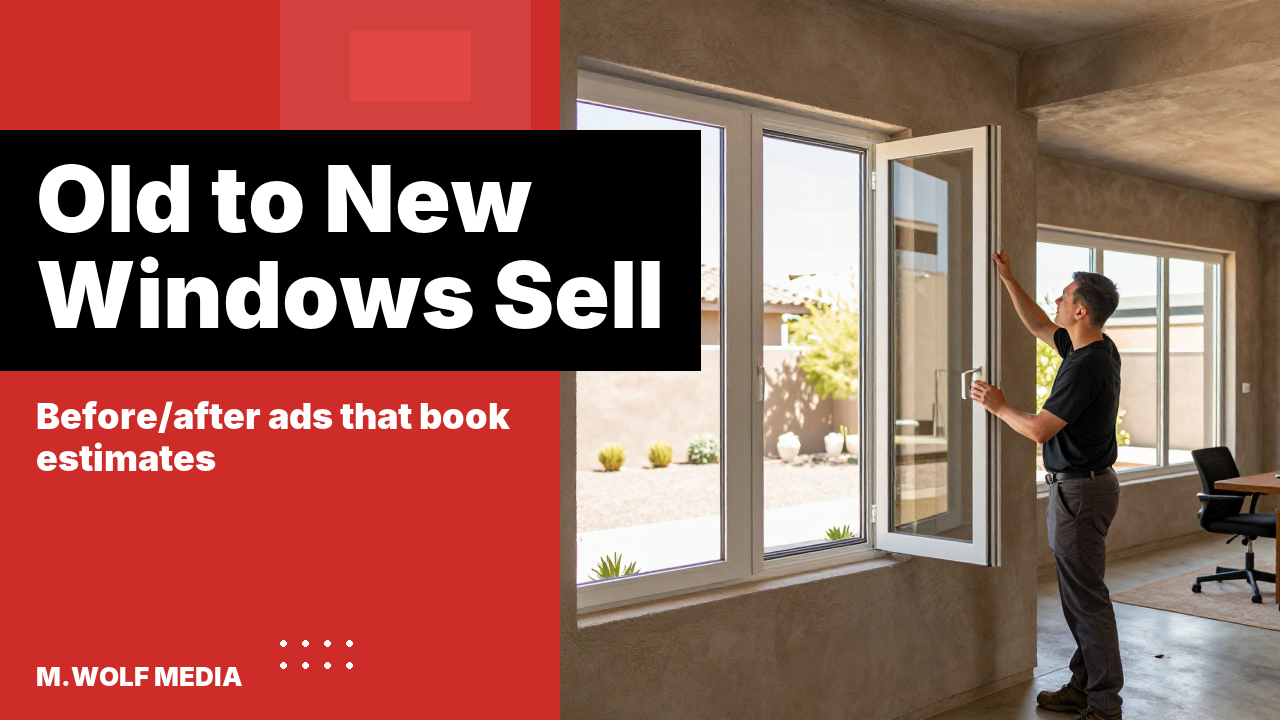
Window and Door Replacement Company Marketing That Books Estimates in 48 Hours
For independent replacement contractors in Queen Creek and across the East Valley, the before-and-after photo is the ad, not the afterthought. Here is how to pair it with Google Ads and Meta ads to book in-home estimates instead of just collecting clicks.
A homeowner in Queen Creek does not wake up thinking about windows. They notice them only when something forces the issue: a cracked seal fogging up the glass, a door that sticks every monsoon season, or a neighbor's house that suddenly looks ten years newer because the old aluminum frames got swapped for clean white vinyl. That last one is the moment window and door replacement company marketing either wins a job or loses it to whichever company runs the better ad.
Independent replacement contractors already have the best possible proof sitting on their phones: real before-and-after photos from real jobs they just finished. Most never turn that into an ad. They run a logo, a stock photo of a smiling couple, or a generic "quality craftsmanship" banner instead, and wonder why the phone isn't ringing. This guide covers why the before-and-after photo should be the centerpiece of every campaign, how to pair Google Ads and Meta ads so each one does a different job, and how to build the follow-up process that turns that interest into a booked estimate before the homeowner calls a second company.
Why Before-and-After Photos Are the Core Asset in Window and Door Replacement Company Marketing
The visual proof problem every independent contractor has
Replacement windows and doors are a hard product to sell cold. The homeowner cannot test-drive a new window the way they can sit in a new truck. They cannot feel the difference between a worn-out aluminum slider and a properly sealed vinyl unit until it's already installed. That makes trust the entire sale, and trust is exactly what a before-and-after photo supplies in a way no headline or price mention ever will.
National survey data backs up why this category sells so well once a homeowner sees it done. According to the National Association of Realtors' Remodeling Impact Report, window replacement earned a 9.6 Joy Score, the highest of any exterior remodeling project tracked, and REALTORS estimate homeowners recover 67 percent of a vinyl window project's cost in resale value. Those are strong numbers, but they only matter once a homeowner believes the transformation is real and happens to houses like theirs. A dramatic side-by-side photo, old frame on one half and new one on the other, does that job instantly.
What makes a before-and-after photo actually convert
Not every before-and-after shot pulls its weight. The ones that convert share a few traits: the "before" photo is unflattering and specific, a yellowed frame, a cracked seal, a door that doesn't sit flush, not a vague stock image. The "after" photo is shot from the same angle, in similar light, so the comparison reads instantly without a caption explaining it. And the house in the photo looks like an actual East Valley home, stucco exterior, desert landscaping, the kind of place a Queen Creek or Gilbert homeowner recognizes as their own street rather than a showroom.
Contractors who batch this correctly treat every completed job as a future ad. A five-minute phone photo taken before the crew tears out the old unit, and the same shot taken again once the new window or door is in, builds a library that a single afternoon of Meta ad creative can run through for months. No studio, no model, no stock license. Just the work the crew already did.
"Every replacement contractor I work with already has the best ad they'll ever run sitting in their phone's camera roll. It's the job they finished last Tuesday. The mistake is treating that photo as something to post once on Facebook instead of the actual creative that goes behind paid media. Once we flip that switch, the cost per lead usually drops within the first two weeks."
Pairing Google Ads and Meta Ads to Turn Curb-Appeal Envy Into Booked Estimates
Google Ads catches the homeowner already searching
By the time someone in Chandler or San Tan Valley types "window replacement near me" or "door replacement company" into Google, they already have a problem they're trying to solve today, not someday. Google Ads and Local Services Ads built around those exact phrases put the before-and-after creative directly in front of that search, with the ad leading to a page that shows the transformation within the first screen rather than a paragraph of company history. That's high-intent traffic, and it converts fastest when the landing experience matches what made them click: real photos, a real local service area, and a clear way to request a free in-home estimate.
Meta ads reach the homeowner who hasn't searched for anything yet
Most homeowners who eventually replace their windows or doors are not actively searching for it the week they first start thinking about it. They're scrolling Facebook or Instagram when a before-and-after photo stops their thumb, because it looks like something that could happen to their own house. Meta ads built around that exact creative, geo-targeted to zip codes across Queen Creek, Gilbert, Mesa, and Chandler, plant that idea before the homeowner ever opens Google. Retargeting anyone who engaged with the page, watched a video, or visited the site but didn't fill out a form keeps that same photo in front of them until they're ready to act.
Run separately, either channel works fine. Run together, they cover both ends of the buying window: Google Ads for the homeowner who already decided and is comparing companies, Meta ads for the homeowner who hasn't decided yet but is about to, once the right photo lands in their feed at the right moment.
| Google Ads | Meta Ads | |
|---|---|---|
| Who it reaches | Homeowners actively searching for window or door replacement right now | Homeowners who haven't searched yet but match the right profile and area |
| Best creative | Headline + before-and-after photo above the fold on the landing page | Short video or carousel built from real before-and-after job photos |
| Funnel stage | Bottom of funnel, high intent, ready to compare quotes | Top and middle of funnel, building interest before the search happens |
| Typical next step | Click to a free-estimate request form or a call | Click to a gallery or form, often after multiple impressions |
A simple way to split a monthly budget: more weight on Google Ads where the local search volume supports it, with Meta ads running underneath to keep the before-and-after library working year-round instead of sitting unused between campaigns. Either channel without a real photo library behind it falls back on stock creative, and stock creative is exactly what every franchise competitor in the market is already running.
Building the 24-to-48-Hour Funnel That Turns a Photo Ad Into an In-Home Estimate
What happens in the first hour after the lead comes in
The ad's job ends the moment a homeowner fills out a form or calls. From there, speed decides whether that interest turns into a booked in-home estimate or goes cold while the homeowner calls the next company in their search results. A lead who just saw a before-and-after photo of a house like theirs is in a specific emotional window: curious, a little envious, and open to acting. That window closes fast. A same-day callback, ideally within the hour, keeps that curiosity alive. A callback two days later is competing against whichever company already showed up and measured the windows.
Why the 24-to-48-hour window is the real target, not "sometime this week"
Booking the actual in-home estimate inside 24 to 48 hours of the first contact matters more than booking it fast on the phone call itself. Homeowners who schedule a measurement visit while the ad is still fresh in their mind are far more likely to keep the appointment and treat it seriously, rather than letting it slide into "we'll deal with it eventually." A simple text confirmation with the crew's name and a photo of the technician, the same kind of visual proof that won the click in the first place, keeps that appointment from getting cancelled once the initial excitement fades.
"The ad gets the click. The photo gets the trust. But the company that calls back in twenty minutes is the one that actually gets the signature on the estimate." Mitchell Wolfert, Founder, M.Wolf Media
Turning the estimate itself into next month's ad
The loop closes the day the crew finishes the next job. That new before-and-after photo goes straight into the same Google and Meta campaigns that generated the lead in the first place, which means every completed job for an independent window and door replacement company funds the ad that wins the next one, instead of a separate photo shoot or stock purchase. Contractors who build this habit into their project checklist, snap the before shot, snap the after shot, from day one usually have a deeper, fresher creative library within a single season than a franchise marketing department updates in a year. That difference is also where most of the paid search and social strategy work actually pays off: not in a cleverer headline, but in never running out of real, local, specific proof.
FAQ: Window and Door Replacement Company Marketing
What makes this approach different from generic home improvement advertising?
Most generic advice and franchise listicles are written for national brands with big production budgets and don't address the one asset an independent contractor actually has: real before-and-after photos from their own jobs. Window and door replacement company marketing that's built around that local, specific proof, paired with Google Ads for active searchers and Meta ads for everyone else, tends to outperform generic brand-style campaigns because it looks like it happened on the homeowner's own street.
Should I use Google Ads or Meta ads first for a window and door replacement business?
If budget is limited, start with Google Ads or Local Services Ads targeting your service area, since that traffic is already searching for the exact service and converts fastest. Add Meta ads once you have a few before-and-after photos to work with, since that channel is built to generate interest from homeowners who haven't started searching yet rather than to capture existing demand.
How many before-and-after photos do I need before running ads?
A handful of strong pairs, five to ten, is enough to launch. The goal isn't volume on day one, it's building the habit of photographing every job so the library keeps growing. Campaigns that rotate fresh creative every few weeks from new completed jobs consistently outperform ones that reuse the same two or three photos for months.
How fast should I respond to a lead from a before-and-after ad?
As close to immediately as possible, and ideally within the same hour. A homeowner who just clicked on a photo that reminded them of their own house is in a short window of genuine interest. The goal is to get the in-home estimate scheduled within 24 to 48 hours of first contact, while that interest is still fresh and before they've called another company.
Is this approach specific to Queen Creek and the East Valley, or does it work anywhere?
The before-and-after photo strategy and the Google Ads plus Meta ads pairing work in any market. What's specific to Queen Creek and the East Valley is the geo-targeting: zip codes in Gilbert, Mesa, Chandler, and San Tan Valley, stucco exteriors and desert landscaping in the photos themselves, and messaging timed around monsoon season door and seal failures that are common in this climate.
Does window and door replacement really recover its cost when a homeowner sells the house?
According to the National Association of Realtors' Remodeling Impact Report, REALTORS estimate homeowners recover about 67 percent of a vinyl window replacement's cost in resale value, and the project earns one of the highest homeowner satisfaction, or Joy Score, ratings of any exterior remodeling category. That resale data is useful in ad and landing page copy, but it's a supporting detail, not the headline. The photo of the actual transformation is still what gets the click.
Keep Reading: More Before/After-Driven Trade Marketing
Want a before/after ad plan built around your own job photos?
We'll put together a free Google Ads and Meta ads plan for your window and door replacement business, built around your real before-and-after photos, so the next homeowner who sees your work books an estimate instead of just scrolling past it. No pitch.
Get My Free Before/After Ad Plan