
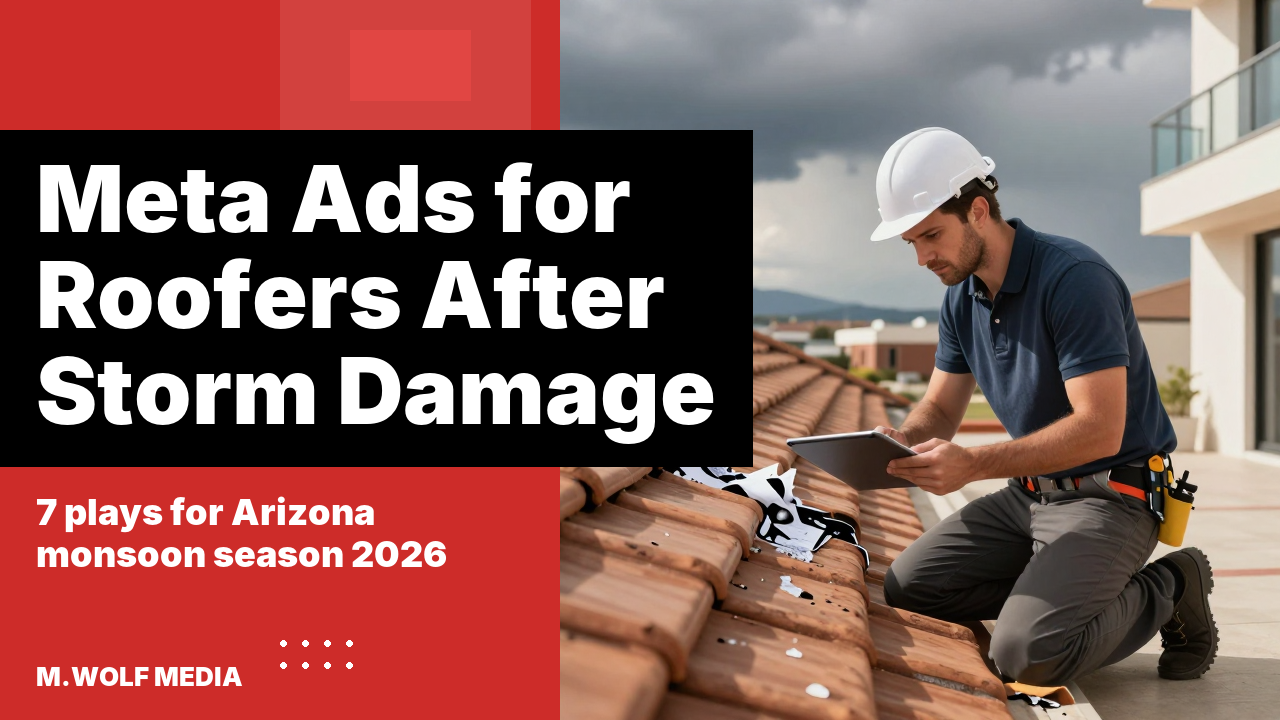
Meta Ads for Roofers: 7 Plays That Turn Storm Damage Into Booked Inspections
Queen Creek and East Valley roofers already get a flood of calls every monsoon season. The crews booking the most inspections are not spending more on ads. They are running a completely different Meta campaign the week after a storm than the one they ran the week before it.
The call volume for Arizona roofers spikes on roughly the same schedule every year: a monsoon cell drops marble-sized hail over Queen Creek or San Tan Valley, and by the next morning half the neighborhood is searching for someone to come look at their roof. Meta ads for roofers are the fastest way to get in front of that exact surge, but most East Valley roofing companies run the same ad in July that they ran back in March, then wonder why it stops converting the moment a homeowner actually needs them.
That gap is the opportunity. A homeowner staring at a cracked tile or a missing shingle an hour after a storm is not browsing. They are deciding, fast, who gets the call before the neighbor's roofer beats them to it. The roofers winning that moment are not the ones spending the most. They are the ones who stopped treating storm season like a normal month and built a system for it.
Below are the seven plays we build into a roofing company's Meta ads account before, during, and after Arizona's monsoon season, in the order they usually need fixing when we audit one for the first time.
Why Meta Ads for Roofers Need a Pre-Season Creative Library
Most roofing companies start thinking about storm-damage creative the morning after a storm, which means the first ad goes out with whatever stock photo was already sitting in the account. By the time a real, local, close-up shot of hail-cracked tile or wind-lifted shingle gets uploaded, the first wave of searches has already gone to a competitor's ad.
The fix is to build the library in the slow season, October through May, while nothing urgent is happening. Shoot close-ups of the actual damage patterns Arizona roofs see: bruised or cracked tile, granule loss on shingles, lifted flashing, dented vents and swamp cooler housings. Thirty seconds of phone video walking a damaged roofline does more work in a Meta feed than a polished logo ad ever will, because it looks like proof, not marketing.
| Generic roofing ad | Storm-ready creative | |
|---|---|---|
| Visual | Stock photo or logo | Real close-up of local damage patterns |
| Timing | Same ad year-round | Swapped in within hours of a storm alert |
| Copy | "Quality Roofing Since 2010" | Names the storm, the date, the affected area |
Build the library before you need it
Keep a running folder of at least a dozen real damage photos and short clips, organized by damage type, so swapping creative after a storm is a five-minute task instead of a scramble. Nothing in the ad needs added text. The damage itself is the hook.
Geo-Fence Your Ads to the Actual Storm Track, Not the Whole Valley
A hailstorm that tears through Queen Creek and San Tan Valley might leave Scottsdale and Peoria completely dry the same afternoon. Plenty of roofing ad accounts still run one broad "Phoenix metro" radius no matter where the storm actually went, which means half the ad spend lands on homeowners whose roofs are fine and have no reason to click.
Because the monsoon window is a known, fixed calendar event, this is plannable instead of reactive. Arizona's monsoon season officially runs June 15 through September 30, per the National Weather Service Phoenix office. Inside that window, pull up the specific zip codes or cities local news and NWS alerts name for a given storm cell, and build (or re-point) a tight Meta location radius around just those areas within the hour, not the whole East Valley by default.
What this looks like in the ads manager
Save a few pre-built audience templates by city, Queen Creek, Gilbert, Chandler, Mesa, San Tan Valley, each with its own small radius, so activating one after a storm is a toggle, not a rebuild. The goal is a campaign that only spends where the roofs actually got hit.
Lead With a Free Storm Damage Inspection, Not a Generic Roofing Ad
"Quality roofing for over 20 years" means nothing to someone who just watched hail bounce off their patio. The offer that actually earns a click in the hours after a storm is narrow and urgent: a free inspection, specifically for storm damage, with a timeframe attached. "We'll have someone on your roof within 48 hours" beats a vague quality claim every time, because it answers the only question the homeowner actually has.
Keep the landing experience just as narrow. A homeowner who clicks a storm-damage ad should land on a page about storm damage inspections, not a general services page they now have to search through to find the relevant offer.
Retarget Everyone Who Engaged With Your Storm Content
Not every homeowner who sees a storm-damage ad is ready to book an inspection the same day. Some are waiting to see if their insurance adjuster calls first. Some just want to watch the video of the hail damage a second time before deciding. That engaged, not-yet-converted group is exactly who a 30-day retargeting window after a storm should be built around, since they already raised their hand once.
That audience is also getting more expensive to reach from scratch, which is exactly why it is worth protecting once you have it. Display retargeting CPMs jumped 18% in January and February 2026 compared with the same months a year earlier, according to AdRoll's Q1 2026 State of Digital Advertising Report. A warm audience that already watched your storm-damage video is cheaper to convert than a cold one is to build in the first place.
"The roofers who win a monsoon season are not the ones who spend the most the day of the storm. They are the ones still showing up in that same homeowner's feed two weeks later, after the first adrenaline wore off and they're finally ready to pick someone."
Win the Call-Back Race While the Insurance Clock Is Ticking
A storm-damage lead behaves differently than a normal roofing lead. The homeowner is often juggling an insurance claim, a deductible, and two or three competing roofers who all ran similar storm ads the same week. Whoever documents the damage first and gets in front of the adjuster's timeline usually wins the job, regardless of who had the better ad.
"After a storm, a roofer isn't really competing on price or even reputation. They're competing on the calendar. Whoever gets a camera on that roof first, and gets the homeowner's paperwork moving first, usually gets picked, because the rest starts to feel urgent the moment one roofer shows up and the others haven't called back yet."Mitchell Wolfert, Founder, M.Wolf Media
The fix is the same one that works for every urgent home-service lead: an instant text confirmation the moment a storm-damage form submits, and a same-day inspection booked while the ad is still fresh in the homeowner's mind. During active monsoon weeks, that response window should be measured in minutes, not the next business day.
Put Insurance Claim Education Inside the Ad, Not Just on the Website
Storm season also brings out traveling crews who show up after a hailstorm, sign roofs up for quick jobs, and leave town before the work holds up. Homeowners have gotten more cautious about that pattern, which means an ad that only yells "free inspection" can get lumped in with the same crews a homeowner is trying to avoid.
A short, genuinely useful explainer inside the ad creative, what a deductible actually covers, what an adjuster looks for, why a local, licensed roofer's documentation matters more than a traveling crew's, does more to separate a legitimate local roofer from a storm chaser than another "free inspection" headline. Since home and home improvement leads already average $42.95 on Meta per WordStream's 2026 Facebook Ads Benchmarks report, a lead that books because it trusts you is worth protecting, not racing to the bottom on volume alone.
What to actually say
Keep it to one clear point per ad: how the deductible works, what documentation an adjuster wants to see, or why a company with a local address and a standing crew is a safer bet than whoever is parked in a truck with an out-of-state plate. One honest, specific point beats five generic trust badges.
Protect Your Ad Account From a Storm-Season Shutdown
The single most avoidable mistake we see during an active monsoon week is a roofing company spiking its daily Meta budget tenfold overnight, right as it starts running heavy damage-claim language across multiple new ad sets at once. Meta's automated review systems read that pattern, rapid spend increases paired with claims-adjacent copy, as a risk signal, and ad accounts can end up in review or restricted for days, which is the worst possible time for a roofer to lose the ability to run ads at all.
The better approach is to raise budgets gradually, in increments over a few days rather than all at once, and to keep claims-related language factual and specific rather than promotional ("documents storm damage for insurance claims" instead of anything implying a guaranteed payout). Warming an account up before peak season, and scaling it deliberately once a storm hits, keeps the ads running through the exact week they matter most.
FAQ: Meta Ads for Roofers in Arizona
Do Meta ads for roofers actually work for storm damage leads?
Yes, especially in the days right after a storm, because Meta ads reach homeowners who haven't started actively searching yet but react immediately to real damage photos from their own neighborhood. The key is swapping in storm-specific creative and a tight geographic radius instead of running the same year-round ad.
When does monsoon season start and end in Arizona?
The National Weather Service Phoenix office defines Arizona's monsoon season as running from June 15 through September 30 each year, with activity typically picking up in July and peaking in August. Roofers can build a storm-season ad calendar around that fixed window instead of guessing.
How fast should a roofer respond to a storm damage lead?
As close to instantly as possible, ideally within minutes during an active storm week. A homeowner dealing with storm damage is usually comparing several roofers and an insurance timeline at once, and tends to book with whoever documents the damage and calls back first.
Should a roofer retarget people who saw a storm damage ad but didn't convert?
Yes, for at least 30 days after the storm. Many homeowners wait to hear from their insurance adjuster before committing to a roofer, and retargeting that already-engaged audience is more cost-efficient than building a brand new cold audience, especially as retargeting costs on platforms like Meta continue to climb.
Why would a roofer's Meta ad account get restricted during storm season?
Meta's automated systems can flag accounts that spike daily budgets suddenly while running claims-adjacent language across many new ad sets at once, treating that pattern as a risk signal. Raising budgets gradually and keeping insurance-related copy factual rather than promotional reduces the chance of a review or restriction right when ads matter most.
What makes storm damage ad creative actually convert?
Real, local, close-up photos or short video of the actual damage pattern a storm left, cracked tile, lifted shingles, dented vents, paired with a specific, time-bound offer like a free inspection within 48 hours. Generic quality claims and stock photography rarely stop the scroll the way visible proof does.
Keep Reading: More Meta Ads and Roofing Guides
Still running the same roofing ad in monsoon season that you ran in March?
We'll look at your current Meta ads, targeting, and storm-season creative, then send back a free plan built specifically for Queen Creek and East Valley roofers. No pitch.
Get my free Meta ads plan