
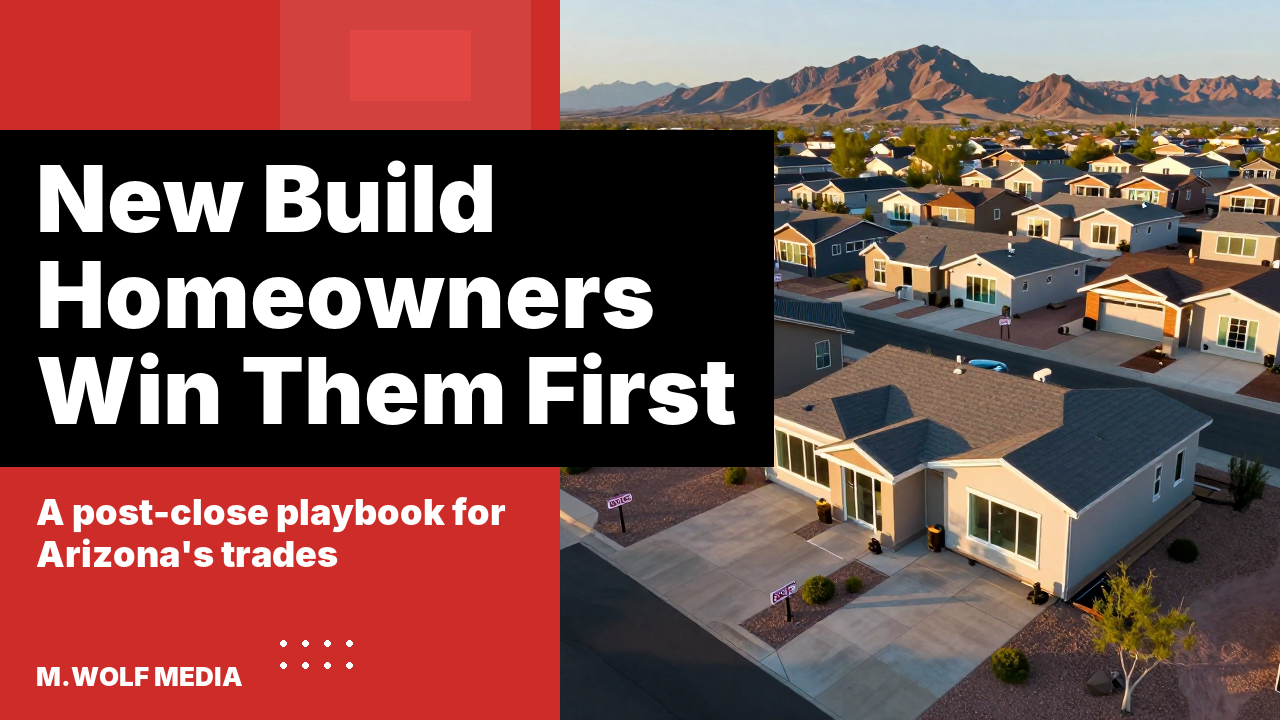
Marketing to New Build Homeowners Arizona: Why the First Vendor Wins
A playbook for landscaping, pool, pest control, and smart-home companies to reach new-build buyers in Arizona's fastest-growing subdivisions, before a competitor's truck beats you to the driveway.
Renee runs a small desert landscaping and pest control company out of San Tan Valley, the kind of two-truck outfit that grows one referral at a time. For most of a year, her new business arrived the way it always had: a neighbor mentioned her name, a past client moved and called again, a Google search turned into an estimate. Then one week in March, her phone rang five times in three days, all from the same stretch of road on the edge of town. None of the callers were past customers. None of them had been referred by anyone she knew. They all closed on their homes within eleven days of each other, in the same subdivision phase, and every one of them needed a landscaper, a pest control plan, or both, immediately.
Renee hadn't changed her ads that week. What she had done, six weeks earlier, was mail a simple postcard to every address on a list of newly recorded deeds in that subdivision, pulled from a title company's public closing data. The postcard went out before most of those buyers had unpacked their last box, let alone looked up a landscaper on Google. By the time a competitor's flyer showed up in the mailbox, or a homeowner thought to search for "landscaping near me," Renee's company was already the one they had decided to call. She hadn't won them with a better pitch. She had simply gotten there first, while the decision was still wide open.
That is the entire logic behind marketing to new build homeowners arizona, and it is a different game than marketing to builders. Builders care about selling the house. Post-close trades, landscaping, pool, pest control, smart-home, security, and similar services, care about what happens after the closing, when a brand-new household with a brand-new yard and a brand-new house suddenly needs every service it never had to think about before. That household has no favorite landscaper yet. No pest control company on speed dial. No pool guy they trust. Every one of those relationships is still unclaimed, and whoever shows up first usually keeps the account for years.
Why New-Build Subdivisions Are a Blank-Slate Market
Most marketing advice aimed at landscapers, pool builders, and pest control operators focuses on winning customers away from a competitor: better reviews, a sharper offer, faster response time. That competition is real, but it assumes the homeowner already has someone to switch away from. A household that just closed on a new-construction home has no one. They need a landscaper because the builder left a yard of compacted dirt or a minimal builder-grade package. They need pest control because every new rooftop in a growing corridor sits on land that scorpions, termites, and other desert pests already considered home. They need a pool company, a smart-home installer, a security system, often within the first few months, and they are choosing a vendor for the first time rather than replacing one.
Arizona keeps generating that opportunity at real scale. The state issued 50,983 residential building permits in 2025, and Maricopa County alone accounted for 31,097 of them, still one of the highest totals of any county in the country even after a slower year compared to 2024's 36,011 permits. Every one of those permits eventually becomes a closed sale, a new household, and a blank slate of vendor decisions still waiting to be made across San Tan Valley, Queen Creek, Buckeye, Casa Grande, and the master-planned corridors pushing out from Mesa and Chandler.
"A lot of trade businesses spend their whole marketing budget fighting over customers who already have a landscaper or a pest control company they're reasonably happy with. New-build subdivisions flip that fight. You're not trying to out-convince an incumbent. You're trying to show up before the homeowner has even started looking, which is a completely different, and much cheaper, kind of marketing problem to solve."
That distinction matters because it changes where the marketing dollar should go. Competing for an existing customer base means outbidding other companies for the same searches and the same reviews. Competing for a new-build household means being the first name a homeowner sees, hears, or receives in the mail, which rewards speed and local targeting over raw ad spend. A company that treats new subdivisions as a separate, deliberate channel, instead of hoping word of mouth eventually drifts that way, is playing a much easier game than the one most of its competitors are stuck in.
What New-Build Homeowners Actually Spend in Year One
The blank-slate opportunity would not matter much if new-build households spent cautiously in their first year. They do the opposite. An NAHB analysis of federal Consumer Expenditure Survey data found that recent home buyers spend considerably more than non-moving homeowners across nearly every category, and the gap is widest in exactly the categories post-close trades sell. New-home buyers spent $3,167 on landscaping and more than $4,000 on patios, walks, fences, driveways, and pools within the first year after closing, compared to just $335 and $512 for existing-home buyers making the same kinds of purchases. Alterations and repairs added close to $12,000 more, and furnishings added another $5,122.
A new-build homeowner isn't deciding whether to spend money on their yard, their pool, or their pest plan this year. They're deciding who gets that spending. The only question that matters is whether it's your company's name they already know when they start making those calls. Mitchell Wolfert, Founder, M.Wolf Media
That spending pattern holds across the trades this playbook is built for. A new yard means a landscaping install, not a mow-and-blow maintenance stop. A new house in scorpion and termite territory means a pest control plan starting from day one, not a call made after the first sighting scares someone enough to finally search for help. A new pool, if the builder didn't already include one, means a full design-build project rather than a repair call. New-build households are not a smaller version of the existing-homeowner market. They are a higher-spending, faster-deciding version of it, concentrated into a narrow window right after closing.
| Category (first year) | New-home buyer spend | Existing-home buyer spend |
|---|---|---|
| Landscaping | $3,167 | $335 |
| Patios, walks, fences, pools | $4,000+ | $512 |
| Alterations and repairs | ~$12,000 | Far lower, per NAHB |
| Furnishings | $5,122 | Far lower, per NAHB |
That table is also the argument for why this channel deserves its own budget line instead of a leftover slice of the general ad plan. A pest control company spending to win existing homeowners away from a competitor is fighting over a customer worth a few hundred dollars a year. The same company reaching a new-build household before anyone else does is competing for a customer who is actively planning to spend on exactly the category that business sells, with no existing loyalty standing in the way.
How to Reach Them Before Anyone Else Does
Speed is the entire strategy, which means the channels that work here are the ones built to catch a household in the narrow window right after closing, not the channels built for steady, ongoing brand awareness. Four approaches consistently outperform general-market advertising for this specific audience.
Recorded-deed mail timed to the closing, not the season. County recorder data and title company closing reports show exactly which addresses just changed hands. A postcard or simple welcome mailer sent within the first two to four weeks after a recorded closing reaches a household before most of its vendor decisions are made, the same tactic that filled Renee's week in the opening story. This works best as an ongoing, automated pull from new closings in a defined set of target subdivisions, not a one-time mailing.
HOA welcome packets and preferred-vendor lists. Most master-planned subdivisions in growth corridors like San Tan Valley, Queen Creek, and the Mesa-Chandler edge have an HOA or community association that distributes a welcome packet to new residents. Getting listed in that packet, or sponsoring a new-resident event, puts a business in front of every new closing in that community at once, without competing against every other company doing general-market advertising in the same zip code.
Geofenced ads around active subdivision boundaries. Paid social and search platforms can target a radius drawn around an actively selling subdivision, reaching phones that spend meaningful time inside that boundary, a reasonable proxy for current residents and frequent visitors. Pairing that geofence with creative that speaks directly to a new-build audience, "just moved into [subdivision name]? Here's what your yard needs in its first year," performs meaningfully better than the same ad run broadly across an entire city.
The businesses that win new-build subdivisions aren't the ones with the biggest ad budget. They're the ones who built a system for finding out about a closing before their competitors did, and then showed up fast enough to matter. Mitchell Wolfert, Founder, M.Wolf Media
Local SEO built around the subdivision name itself. New residents search for their own community by name constantly, checking local news, nearby amenities, and recommendations. A landscaping, pest control, or pool company with content and Google Business Profile posts that mention specific subdivision names by name shows up in exactly those searches, often with far less competition than a generic city-wide keyword would ever allow.
None of these tactics requires marketing to the builder, negotiating a referral fee, or waiting for a sales office to agree to a partnership. They reach the homeowner directly, the moment the house becomes theirs, which is the entire distinction between this playbook and the builder-facing marketing most trade businesses default to instead.
Building a System That Doesn't Miss the Next Phase
Renee's postcard worked because a new subdivision phase closed escrow in a tight window and she happened to catch it. The version of this that actually scales a business is not catching lucky timing once. It is building a repeatable system that checks for new closings every month, in every growth corridor a business is willing to service, and fires the same sequence automatically every time.
That system has three parts. First, a standing list of target subdivisions and growth corridors, reviewed quarterly as new master-planned communities break ground and older ones finish selling out. Second, a recurring pull of newly recorded closings in those areas, whether through a title company relationship, a data service, or a simple manual check of public recorder filings. Third, a fixed outreach sequence, mail plus a geofenced ad plus a follow-up call or text, that fires automatically whenever a new batch of closings appears, instead of depending on someone remembering to act on it.
The payoff compounds. A pest control company that lands a new-build household in year one is very likely keeping that account for years, since most homeowners do not shop around for pest control once a relationship is working. A landscaping company that designs the first yard typically gets the maintenance contract that follows it. Winning the first call is not a one-time sale. For most of these categories, it is the start of a multi-year customer relationship that never had to be fought for, because no competitor got there first.
FAQ: Marketing to New Build Homeowners Arizona
What does marketing to new build homeowners arizona actually mean, versus marketing to builders?
Marketing to builders means pitching a construction company for a referral partnership or a preferred-vendor contract before homes are even sold. Marketing to new build homeowners arizona means reaching the actual buyer directly, right after they close escrow, before they have chosen a landscaper, pest control company, pool builder, or smart-home installer. It targets the household, not the company that built the house.
How much do new-home buyers in Arizona actually spend on landscaping and outdoor projects in the first year?
An NAHB analysis of federal Consumer Expenditure Survey data found new-home buyers spend $3,167 on landscaping and more than $4,000 on patios, walks, fences, and pools in the first year after closing, compared to $335 and $512 for existing-home buyers making the same kinds of purchases. That gap is the core reason this audience is worth marketing to separately.
How fast after closing should a trade business try to reach a new-build homeowner?
Within two to four weeks of the recorded closing, before most new owners have researched or hired a vendor in categories like landscaping, pest control, or pool service. Recorded-deed mail and HOA welcome-packet placement are built specifically to land inside that window.
Is Arizona's new-home market still growing enough to build a whole marketing channel around it?
Yes. Arizona issued 50,983 residential building permits in 2025, with Maricopa County alone accounting for 31,097 of them. Even with 2025 running below 2024's pace, that is still a steady, ongoing supply of new households with no established local vendors across growth corridors like San Tan Valley, Queen Creek, and Buckeye.
Which post-close trades benefit most from a new-build homeowner marketing strategy?
Landscaping, pool design-build, pest control, smart-home installation, and security systems benefit most, since nearly every new-construction home needs these services from scratch rather than replacing an existing provider. Any trade a new homeowner has never had to hire before is a strong fit for this playbook.
Keep Reading: More Lead-Gen Playbooks
Want to be the vendor new-build homeowners call first?
We'll build a free new-homeowner marketing audit for your service area: which growth corridors to target, how to reach new closings fast, and what a first-30-days outreach sequence should look like for your trade.
Get my free marketing audit