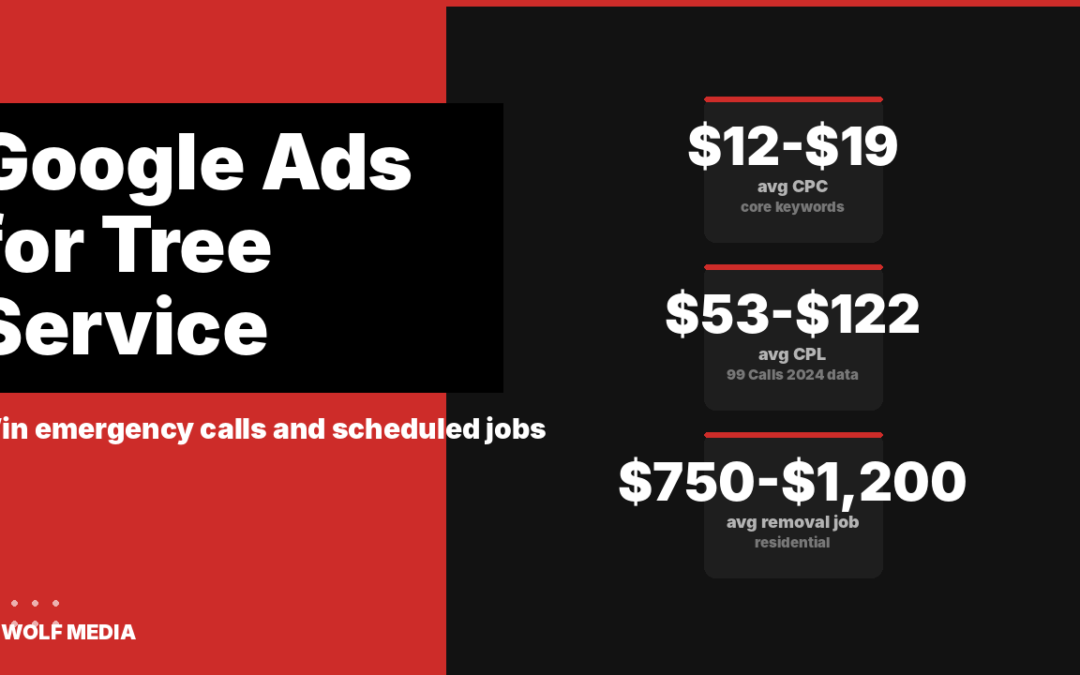
Google Ads for Tree Service Companies: How to Win Emergency Calls and Scheduled Jobs in 2026
The two-campaign strategy that separates tree service companies generating consistent leads from those burning budget on irrelevant clicks.

Tree service Google Ads accounts fail in a specific and predictable way. A company sets up one campaign, throws in "tree removal" and "tree trimming" on broad match, sends all traffic to the homepage, and wonders why their cost per lead is $180 while a competitor down the street is generating calls at $65.
The fix is not a bigger budget. It is structure. Emergency tree removal and scheduled tree trimming are fundamentally different services with different buyer psychology, different CPCs, different close cycles, and different optimal bid strategies. Running them together in the same campaign means Google is making one averaged decision when it should be making two very different ones.
This guide covers what it actually costs to run Google Ads for a tree service company, how to structure emergency and scheduled campaigns separately, and how to build the negative keyword list that is the fastest single ROI improvement most tree service accounts can make.
💵 Part One: What Google Ads Actually Costs for Tree Service Companies
Tree service keywords are some of the most specifically priced in the home services space. SerpWars keyword data from 2026 puts "tree removal" at $18.63 CPC, "tree service" at $18.23, and "arborist" at $18.40. Emergency removal terms run higher: "emergency tree removal" averages $21.60 per click nationally, with major metro markets pushing $40 to $65 per click when a storm has just hit and every company in the area is bidding on the same terms.
These CPCs reflect real buyer intent. Someone searching "tree removal near me" has a tree they need taken down. Someone searching "emergency tree removal" has a tree that needs to come down today. The urgency is priced into the auction.
CPL benchmarks from actual campaign data
99 Calls publishes monthly CPL data for tree service Google Ads campaigns across hundreds of accounts. Their 2024 data shows:
| Season | CPL Range (10th–90th percentile) | Notes |
|---|---|---|
| Low season (October, December) | $42 – $91 | Lower competition, easier to acquire leads |
| High season (August, November) | $78 – $159 | Peak competition, storm aftermath demand |
| Annual median | $53 – $122 | Median campaign, not best-in-class |
| Well-optimized campaign | $53 – $85 | Strong structure, solid negative list, dedicated LP |
For context, the LocaliQ 2025 benchmark puts the landscaping category (the closest tracked subcategory) at $117.92 CPL and the overall home services average at $90.92. A well-run tree service campaign consistently beats both of those benchmarks.
"A $70 Google Ads lead that becomes an $850 tree removal job has a 12x ROAS before repeat business or referrals. The economics are there. The problem is almost always structure, not the platform." Mitchell Wolfert, M.Wolf Media
What a realistic monthly budget looks like
| Monthly Budget | Est. Leads (peak season) | At 40% Close Rate | Revenue Potential |
|---|---|---|---|
| $1,000 | 10 – 14 | 4 – 6 jobs | $3,400 – $5,100 |
| $1,500 | 15 – 22 | 6 – 9 jobs | $5,100 – $7,650 |
| $2,500 | 25 – 36 | 10 – 14 jobs | $8,500 – $11,900 |
These use $70 CPL and $850 average job value (residential removal). Emergency jobs skew higher — emergency tree removal can reach $3,000 to $5,000 per job in the right market conditions. A single storm event that produces 5 emergency calls from your campaign pays for weeks of ad spend.
The $39.5 billion market most tree companies under-capitalize on
IBISWorld puts the US tree trimming services market at $39.5 billion in 2025, growing at 2.4% annually. There are 175,035 tree service businesses in the country competing for that revenue. The ones capturing consistent Google-driven leads are a fraction of the total — most tree companies rely on word of mouth and seasonal repeat business. Running Google Ads well is how you take market share from that majority.
⛏ Part Two: The Two-Campaign Structure for Tree Service
The most common mistake in tree service Google Ads accounts is running all services in a single campaign. Tree removal, trimming, stump grinding, and emergency response are four different services with four different buyer states. Treat them differently.
Campaign 1: Emergency removal (runs 24/7)
Emergency tree removal is a crisis purchase. A homeowner at 10 PM with a tree on their fence is not comparing prices. They are calling the first credible number they see. This campaign runs 24/7, uses call-only ads, and bids to be position 1 every time an emergency term fires.
Keywords: "emergency tree removal near me," "24 hour tree service," "tree fell on house," "tree on fence," "storm tree removal," "emergency tree service."
Landing page: not needed for call-only ads, but your phone tracking number must connect immediately. An unanswered emergency call at 10 PM is a lost job. If you cannot staff a 24/7 phone line, use an answering service for after-hours emergency calls rather than letting them go to voicemail.
Campaign 2: Scheduled services (runs business hours)
Scheduled work — trimming, planned removal, stump grinding, dead tree removal — comes from buyers who are researching and comparing. They will fill out a form, read your reviews, and schedule a quote for next week. This campaign runs your actual business hours, uses standard text and responsive search ads, and points to a service-specific landing page with a form.
Keywords: "tree trimming near me," "tree removal cost," "stump grinding near me," "arborist near me," "tree pruning service," "dead tree removal." Each major service type gets its own ad group and its own landing page.
Campaign 3: LSAs (always on)
Local Service Ads for tree service companies appear above all other search results, operate on pay-per-lead, and carry the Google Guarantee badge. Tree service / arborist is an eligible category. Average CPL through LSAs runs $20 to $60 versus $53 to $122 for standard Google Search Ads. Running all three simultaneously — emergency Search, scheduled Search, and LSAs — covers the SERP comprehensively.
The negative keyword list: your most important optimization
Tree service keywords on broad or phrase match attract an enormous range of irrelevant traffic. Multiple tree service PPC practitioners report that negative keywords alone reduce wasted spend by 30 to 50% in the first month. Here is the list to start with:
| Category | Terms to Block |
|---|---|
| Wrong "tree" | Dollar Tree, Christmas tree, family tree, family tree maker, money tree, Joshua tree |
| Free programs | free tree removal, free tree removal program, USDA tree removal, utility company tree |
| DIY | how to cut down a tree, DIY tree removal, rent a chainsaw, tree removal permit |
| Job seekers | tree service jobs, arborist jobs, tree trimmer jobs, tree climber hiring |
| Products | tree service software, tree trimming tools, arborist equipment, chainsaw |
"In tree service accounts, negative keywords are not a one-time setup. Check your search term report weekly for the first 60 days. You will find at least 5 new terms to block every week." Mitchell Wolfert, M.Wolf Media
Ad scheduling and call-only ads
Over 70% of tree service searches happen on mobile. Call-only ads, which show a phone number and click-to-call instead of a link to a landing page, outperform standard text ads for mobile emergency searches because they remove the landing page step entirely.
For scheduled service campaigns, responsive search ads with at least 10 headlines and 4 descriptions give Google enough variation to match ad copy to specific queries. Include social proof headlines (number of reviews, years in business, certifications) alongside service-specific ones.
🌿 Part Three: Seasonal Timing and LSA Strategy for Tree Companies
Tree service demand is not evenly distributed across the year, and neither should your ad budget be. Understanding the seasonal pattern lets you spend more when leads are cheapest and capture storm-driven emergency demand before your competitors even realize it is happening.
The seasonal breakdown
The 99 Calls 2024 CPL data by month reveals a pattern that mirrors demand cycles closely:
- Spring (March to May): Primary scheduled work season. Homeowners assess their yards after winter and book trimming, pruning, and dead tree removal. CPL is moderate. Ramp budgets in late February.
- Summer (June to August): Storm emergency peak. Heavy thunderstorms, derechos, and hurricane season (June 1 through November 30) drive unpredictable but high-value emergency demand. August is one of the highest-CPL months due to intense competition.
- Fall (September to October): Second scheduled work season. Leaves falling reveals dead branches. Many homeowners want cleanup before winter. CPL is often lower than summer.
- Winter (December to February): Lowest demand in most markets, but also lowest competition. December CPL drops significantly. Good time to build brand awareness, capture winter storm damage, and book spring jobs in advance.
Storm response: how to capture emergency demand in real time
The tree service companies that capture storm demand are the ones who already have campaigns live when the storm hits. Setting up a campaign in response to a weather event means 24 to 48 hours of lag time. Competitors with established campaigns start getting emergency calls within hours.
Use Google Ads automated rules to increase emergency campaign budgets by 50 to 100% when weather alerts trigger in your service area. Even a basic rule — "if the day is Saturday after a major storm, increase budget by X" — can be set up in the Automated Rules tool. More sophisticated setups use scripts or third-party bid management tools that pull weather data directly.
LSA setup for tree service
Tree service and arborist are explicitly listed as eligible LSA categories. The verification process requires a background check, license (ISA Certified Arborist certification or state contractor license, depending on your state), insurance verification, and a verified Google Business Profile.
Your Google Business Profile review count directly affects your LSA ranking. Tree service companies with 40 or more reviews consistently appear more often and at lower CPL than those with 10 or fewer. Build a systematic review request process — after every job, text or email the customer with a direct link to your Google review page.
Average LSA CPL for tree service: $20 to $60. Google Search Ads median: $53 to $85. Running both simultaneously means LSAs capture top-of-SERP trust clicks at low cost while Search Ads capture specific keyword intent where you need more targeting control. See Google's Local Services Ads page for current eligibility details and to check your service area coverage.
Building a campaign that compounds over time
The tree service accounts that generate $65 CPL today started at $120 CPL six months ago. Optimization is cumulative. Every week you review your search term report and add negatives, your wasted spend decreases. Every month you accumulate conversion data, Google's algorithm gets better at identifying which searches convert to booked jobs. Every review you collect improves your LSA ranking and organic visibility simultaneously.
The contractors who treat Google Ads as a long-term asset rather than a quarterly test compound these advantages over time. The ones who turn ads off in November and restart in April are starting over every spring, paying higher CPCs and competing for the same leads they could have captured more cheaply in February.
Free Tree Service Google Ads Starter Kit
Everything you need to launch or fix your campaign this week.
- Emergency vs. scheduled campaign structure template
- Master negative keyword list: 60+ terms that drain tree service budgets
- Ad scheduling guide: when to run emergency vs. scheduled campaigns
- LSA eligibility checklist for tree service companies
Frequently asked questions
How much should a tree service company spend on Google Ads?
Most tree service companies start at $1,000 to $1,500 per month for a single metro service area. Companies covering larger territories or prioritizing emergency response often spend $2,500 to $5,000 per month. Tree Care Marketing Solutions recommends budgeting $1,000 to $2,000 for an initial 2 to 4 week test before drawing conclusions about CPL.
What is a good cost per lead for tree service Google Ads?
A well-optimized tree service campaign should produce leads at $53 to $85 during most months. The 99 Calls 2024 benchmark data shows median CPL ranging from $53 in low-competition months to $122 in peak months. If your CPL is consistently above $120, look first at your negative keyword list, then at your landing page, then at your geographic targeting.
Should tree service companies separate emergency and scheduled campaigns?
Yes, absolutely. Emergency removal and scheduled trimming have different CPCs, different buyer intent, different optimal ad schedules, and different landing page requirements. Running them in the same campaign means Google averages your bids and underperforms on both. Emergency campaigns should run 24/7 with call-only ads. Scheduled campaigns should run business hours with standard text ads and form-based landing pages.
Are tree service companies eligible for Local Service Ads?
Yes. Tree service and arborist are eligible LSA categories. LSAs appear above standard paid search results and carry the Google Guarantee badge. Average CPL through LSAs runs $20 to $60, roughly 30 to 50% lower than standard Google Search Ads. Running both simultaneously gives you two SERP positions and maximizes lead volume.
What negative keywords should tree service companies use?
Start with: Dollar Tree, Christmas tree, family tree, free tree removal program, DIY tree removal, tree service jobs, arborist jobs, tree trimming tools, chainsaw, Joshua tree. Check your search term report weekly for the first 60 days and add new negatives every week. Practitioners consistently report that a thorough negative keyword list reduces wasted spend by 30 to 50% in the first month.
When should tree service companies run Google Ads?
Year-round, with higher budgets in March through May (spring scheduled work) and September through October (fall work). Emergency campaigns should run 24/7 regardless of season because storm damage is unpredictable. The off-season (December through February) often has the lowest CPL due to reduced competition, making it a cost-effective time to capture storm damage leads and book spring jobs in advance.
Keep reading
Ready to get more leads from Google?
Tell us about your current setup and we will show you exactly where to start.
Tree Service Google Ads Starter Kit
Emergency vs. scheduled campaign structure, negative keyword list, and LSA eligibility checklist for tree service companies.
No spam. Unsubscribe anytime.
What is your biggest Google Ads challenge right now?
What is your monthly Google Ads budget (or what are you considering)?
Last step. Where should we send your free audit?